Inside, today

OLYMPUS DIGITAL CAMERA

My Shirt

OLYMPUS DIGITAL CAMERA

Holding It Together

OLYMPUS DIGITAL CAMERA

Running Away From Home

OLYMPUS DIGITAL CAMERA

Time Stopped, Cat Leaving

OLYMPUS DIGITAL CAMERA

Racines Adventives, Atlas

OLYMPUS DIGITAL CAMERA

Tortoise With Head Held back

OLYMPUS DIGITAL CAMERA

Ginger in A Bowl

After Reading, “Miracle Fair” but Wislawa Szymborska

This year I like poems that are lists.

Yesterday I was bored so I took a bunch of pictures of things in my house. This shirt for one. It was one of Charlie’s. He was very hard to buy presents for so I resorted to T-shirts from places we visited. This is a nice rayon shirt with batik fish. It is not a quiet shirt.

I have been setting the camera on the kitchen counter and taking pictures of what is there with a little staging. It changes every day.

Yesterday there was a peach that I had cut in half. The shot from above wasn’t satisfying so I leaned it against a bowl so the beautiful orange and red flesh glowed in the middle. There is a bowl of dark plums behind it and in the distance my tea kettle and coffee grinder. The cabinet roof looms over everything looking very industrial. And a corner of the spice rack shows in the top left. Out of focus. Deleted. Not all the pictures made the cut.

An aerial shot of a small drawer full of paper clips and binder clips and a round container and some white wire bag ties and some string.

A picture of a picture with a little tray of gravel and a salt and pepper shaker set that is a blue car pulling a white trailer. I made that up to look like the car and trailer were going through the scene of the picture. It didn’t work very well. There are also S&P shakers in the form of cactus.

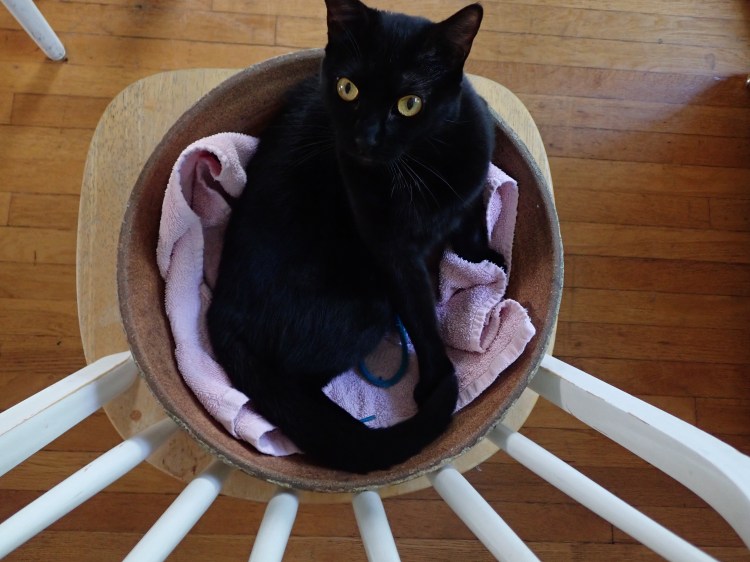
My cat Ginger through the bars of the chair-back. She is sitting in a large bowl that used to be on the table with my sun hats. I couldn’t keep her off the table as long as the bowl was asking her to fill it. Now the bowl is on the chair with a towel in it. Bert, the other cat is sleeping on another piece of furniture that has been surrendered to the cats. He has to be near a window. He is a window addict like I am a solitaire addict. He watches things move out there. I wish he wouldn’t kill them if I gave him the chance.

The water stains in my dining room ceiling. I am taking pictures of them periodically to diagnose what is causing them. It could be rain, it could also be the bathtub is leaking.

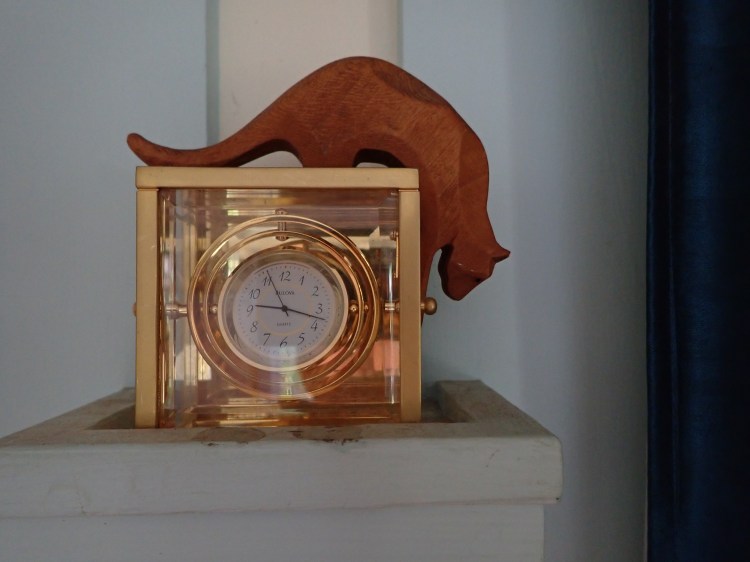
My going away  clock from when I ‘retired’ from BBI, the construction firm where I worked for many years. It’s in a brass  and glass box and the battery wore out years ago. There is a wooden cat climbing down off of it.

All my shopping bags that are in temporary retirement because of the plague. And two melons that Karen, my part-time roommate bought at TJ’s on Saturday.

An extension cord laying helplessly on a mahogany dresser in the dining room.

A face mask laying on the table. It made me laugh because it looks like a pure white tortoise with its head and feet pulled in.

My bookcase with lamp and pictures. It’s a pretty alcove of warmth in the living room.

The Invention of Heaven

If I were in charge of inventing Heaven, what would I do?

I will have dandelions blinking, out of the grass, bright yellow then impossibly fragile white balls, then the little inverted umbrellas floating away on the breeze, tiny Mary Poppins hanging from each seed.

I will keep my friends but I wouldn’t force them to come to my heaven, besides they will be busy inventing their own. I’ll throw in a few suggestions if I may.

I will keep this room as full of its spirit of kindness as possible. I will probably redesign this cement walled room to have wood floors and walls and a lower ceiling to trap the heat. The cathedral ceiling is lovely but not efficient. I will keep the windows and I will allow the view to change every day. Sometimes I will substitute views of Yosemite, the deserts of Nevada and Utah, sunrises anywhere, sunsets. Sometimes I will give the view a rest by filling the air with fog.

I will keep chocolate. I will keep Ben and Jerry’s ‘Cherry Garcia’ ice cream and their ‘chocolate fudge core.’ I will keep potatoes in all their delicious forms and corn on the cob, sometimes with butter and sometimes just the sweet kernels, and smokehouse almonds, and salads on hot days and soup on cold ones.

I will have sudden rain storms to clear the air and snow storms to shut us in and make a fire to keep cozy and warm. I will have lightning and thunder in the mountains and a dry tent by a river.

I will keep my jobs because I like the variety of people and experiences they provide. I like solving the puzzles

I will keep my cats and my daughter and husband – but not in that order.

In heaven I will be busy but with some empty time where I can stare and think.

The Christmas decorations will spontaneously appear all over the house and on January 7th they will begin to disappear, one at a time, just when I stop noticing their glitter and shine. None of the light bulbs will burn out.

The furniture will all weigh 10 pounds so I can move it around. It can weigh what it likes the rest of the time.

I will wash my face in many rivers and not worry about giardia. There will be sleek and cheerful otters on the banks. My cats will be able to transform into otters when they feel like it. I won’t need a boat to swim in Class II rapids and the water will be warm and there will be a large quiet pool at the bottom with friends smiling at me on the bank, tossing me a rescue rope. I will be able to hike the whole Pacific Crest trail in one long summer without a backpack. I’ll make it hard, but not impossible. I will raft down the Grand Canyon every time I want to feel small. I will paddle the Smith River in Montana when I want to laugh and take pictures of wildflowers and eat dinner with people I love. We will sit by the river and watch Mergansers and Falcons and Night Hawks and Golden Eagles. There will be the damp smell of distant rapids on sunny days. There will be a piece of duck-down slowly spinning on deep, dark, silent waters.

I want to take pictures of everything so I can show my friends what my heaven looks like.

People will be assigned death dates where they will blink out of time. Those who want to know when they are going to die can send an email to the powers that be. The others, because they aren’t afraid of the suffering that often accompanies death, will accept death as a partner to their life. They will be looking forward to reinventing heaven.

I am going to invent a system that creates random events but I am not going to dread anything.

Maybe that is the essential part of my heaven, the engine that runs it. No dread, no worry. I want to feel like I belong and that I will be able to face whatever comes next. Dread is the feeling I get when I am not sure about this.

The thought that I am already in heaven keeps interrupting me. I know I am not there because I am always dragging that bag of anxiety and uncertainty behind me, but I am close sometimes. I can feel it.

I can feel how close heaven is to me even when there is nothing I can do to change this world. Its like the beginning of a sneeze before you know its going to be a sneeze. There is something there but it hasn’t announced itself. There is already a heaven, I don’t have to invent one, and it’s very, very close.

It would be a good idea to leave that nasty bag of woes someplace where it can’t do any harm. Maybe in Area 51. But it does provide a contrast, doesn’t it? And maybe that bag of anxiety is actually what is keeping me alive and when it is time to leave it somewhere, that will be when I get to the final draft of heaven.

After ‘The Invention of Heaven’ by Dean Young


To Jane Hirshfield

The Rest-Note

The moment between the injury and the cry.
The breath taken before saying an unwelcome truth.
4 AM in a Redwood forest – even the owls are asleep.
The sound of the bell before it is struck and after its music fades.
The moment of astonishment after your hand caught the falling child.
Everything that isn’t between you on the top of Half Dome and the Merced River below.
The moment when you realize you have fallen in love.
The moment when you realize you have fallen in love with the wrong person.
The moment when the voice on the phone says, “He’s dead.”
The space between the ceiling and the roof.
A mouse when it sees the cat.
A cat when it sees the mouse.
The sound of a leaf letting go of its branch.
The moment after the pilot says, “Oh, shit.”
The moment after “I do.”
The moment before the baby’s first breath.
The moment when you flip the switch and nothing happens.
Stopping the car in the middle of highway 395 when you haven’t seen another car for an hour and the only sound is the ticking of the cooling car and the crunch of gravel that has gathered between the double yellow line as you spin slowly to see Spring daring the desert plain. Then you breathe to break the silence.
The space between the Earth and the Moon. The space between atoms in your cup of coffee.
The space between inhaling and exhaling.
Sleep.
The seconds between the flash and rumble and the seconds before the rain and hail pound the walls of your tent and the sound of dripping afterwards. The long pause between the drops.
The darkness when you blink and the light when you eyes are open again.
The smell of your mother’s Shalimar perfume after she’s been dead for 20 years.
The moment when you realize your wallet is missing. Your credit cards. Your journal.

Thanks to Rilke

Ich Liebe meines Wesens Dunkelstunden
I can’t say I LOVE the dark hours of my being. Maybe that is some existential hyperbole.
I know I am shaped – even fertilized- by that underground stuff, but, it often depresses me and leaves me with no energy to pull myself up by the bootstraps. I have wasted enough of my life in continuous  apathetic ‘what’s the point’ monologs.
I like the idea of ‘the darkness’ being a legend, a tale that I have been telling as it happens. Sometimes I am literally writing up events as they happen.
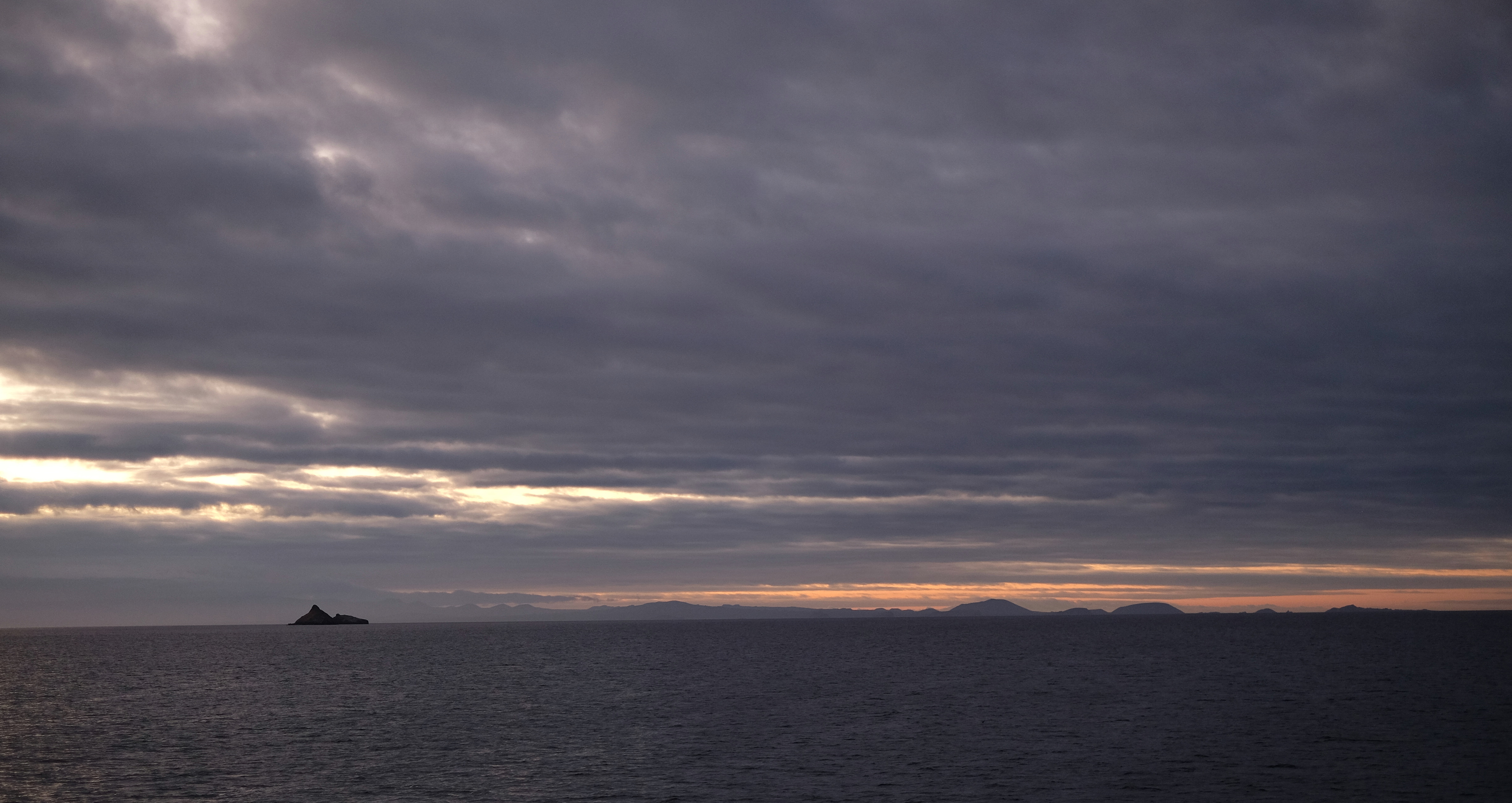
I have a photo of the Galapagos that speaks to me more and more every time I look at it.
It’s a seascape with a rough and cloudy sky with a smudge of orange on the horizon and darker, slate blue ocean. In the distance, almost indistinguishable from the sea and sky is an island – long and low – forming the horizon line. If you look closely, you can see a finger of morning fog sliding into a bay, hidden by a short peninsula. Closer, in bright black, there is a small island, maybe the tip of an ancient volcano- a rough pyramid alone in the sea.
Sometimes when I look at the picture I am looking for the fog that defines the shape of the shadowy island. I have to peer closely to make it out. There is something about that tiny detail, one that no one else would notice, that makes me happy.  I love the way the fog gives shape and depth to the hidden bay and three dimensionality to the rest of the island.
When I stand away from the picture I have a moment of loneliness. The solitary black island is alone in the vast blues and greys of the sky and sea. The island is so small and exposed there might not be any land-life on it. I can see myself cold and shivering, sitting on top of it after a disaster. I am searching for rescue and seeing the larger distant island gives me no hope because I could never swim that far.
Then, without any thought, my feeling goes from loneliness to hope. I am not quite sure how that little pyramid of blackness can be both lonely and hopeful at the same time. The hopeful bit has something to do with time and how long the ocean has been pounding – sculpting – that rock. The Galapagos are volcanic. The new lava-formed islands to the West are large and the volcanoes still quite active. The Eastern islands have been abandoned by the Earth’s volcanic machine and the sea has been able to chew them down into little nubs scattered across miles of open sea.
Time.
There is something about the amount of time it took for a large volcanic island to be reduced to the size of a small pyramid that gives me hope. How is it possible that humans can be this little speck of life sitting in the middle of the ocean, cold and shivering – waiting for rescue. The planet will continue to orbit the sun in our galaxy and our future as a species is uncertain, but, in the life of our galaxy or even the life of our planet, we are beautiful and absolutely unique. Each one of us organic life forms is the result of all this time, all this stuff coming together and falling apart for billions of years.
To the human eye everything is light.  We only see things when the light touches them. If there was no light, we would know nothing beyond what we could smell and touch and hear. The sky wouldn’t be blue, the stars wouldn’t shine, the sun would only be hot time and cold time. Maybe we would sleep during the warm time and be awake, hunting during the cold time.
Maybe there is no such thing as darkness without eyes.
The feeling of hope I feel when I look at my photograph is also tied to the beauty I see there. Tied to my feeling that I was extremely lucky to see that island and take that picture and be alive in the world at that moment.

Thanks to Apollinaire

The Walk to Pam’s

On a mossy, low, cement wall a tiny doll stands on a flat spot. She’s an inch high and has feet the size of ants. Her hands are folded in front of her bright red knee length dress. She is painted white; face, hands and lower legs. Her long hair and tiny feet are painted black. A middle-class lady from the 50’s, Doris Day or Mrs. Cleaver. Below her, graffiti in wide white letters, each letter five times her height, says:
EMPTY
punctuated with a little heart. Which came first? Which one was a comment on the other?
The street ahead is wet and empty. The sidewalks are dark, it rained during the night and the colors are intensified by the water. A car goes by making that hissing noise you only hear when a car goes by after the rain. Not the deep splashy hiss when the rain is falling but the lighter one, when the water has had an hour or so to drain away. I remember the feeling of joy and excitement I felt on a rainy night when I was in college. Many people moved swiftly along the paths, some laughter floated across the quad. Light pooled at the foot of lamp poles and reflected on puddles and the yellow light made the bright green of the grass glow in the darkness. I was going to class and looking forward to it. I was looking forward to change.
In front of the Live Oak Recreation building there is a tot lot. There is a play tower, very high, that looks like a castle because of the conical roof over a round tower. It is made of thick plastic. An orange tube, like a sewer pipe, curves from the top to the ground; a slide for short people. It’s a weird thing, as if assembled from leftovers, the scraps of construction materials. Its ugly, as much children’s architecture is, made to last, then to attract the eye of someone who likes shiny bright things. Bubble gum colors, huge fun to play on when you are three. At the gate someone taped up a sign telling the older children to stay out so that the little kids will be safe. I saw that sign when I went to vote at the center last November. I wonder if it is still there.
A flock of small children, herded by three adults comes hopping up the path from the creek in the park. They are wearing various colors of rain gear. Some walk happily, others with purpose, some are examining the ground in front of them very carefully as they try to keep up with the mob. One tall girl is wearing a single piece rainsuit. It fits her very well, the cuffs at her wrists and ankles are the perfect length. She walks confidently, head up, giving a little skip every few steps. She is the age where she will wear that red suit until it either shreds off her or she has grown so tall she can’t get it over her shoulders. It looks durable so my bet is on the outgrowing.
I want to take a picture of the picnic area set in a flat spot near the creek, but the trees and shrubs are so chaotic I can’t see anything but leaves and stems. I know the shot will be a mass of confusing greens and yellows and black. Nothing one can focus on with a camera. I know what it should look like but I can’t capture it. Besides part of why I want to take the picture is that I think about the fire pit downt there and if it would really make sense to have the Christmas tree burning down there. There are often homeless people camped out in that glen, too. I would feel like I was invading their space. I like the idea of burning the Christmas trees. It is so dramatic and a little frightening how fast they go up in flames. But the smoke is a problem. My lungs don’t like it and it isn’t good for the environment. Much better to chip the trees and then put them in the compost. Everytime I pass this spot on my way to Jeanna’s I think about this non-party I won’t be having.
As I pass the Berkeley Art Center and approach Oxford street there is a graying wood fence along the path. A perfect place for graffiti:
NERD!

in baby fat letters. When I was growing up Nerd was one of the worst insults. A Nerd was someone who did their math homework in five minutes and then wanted more homework because the problems were interesting. They were not sports, they were not romantic or cute or handsome. They were intelligent and inventive but if they had lived in another time they would have been ostrasized for their extreme shyness and inability to deal with people. When I was young, they were tolerated, but just barely. Being a nerd was not cool. They were smartass, not just smart. Since the computer age was created by Nerds, the word has changed its meaning. There might be a little resentment in it, but it is the kind of ambivalence that the poor have for the rich; An example of this reasoning: “I want to be rich, but it is the assholes who are rich.” Which leads to this kind of resonaing, “I wish I could be a creative genius, I would like to be one of the Nerds who created video games and iPhones. But they are not exactly human, they are Nerds. I would rather play the game than learn how to make the game.” To the Nerd making the game IS the game.
I love only one thing about the Fall, in our semi-arid Berkeley the rains bring a Spring of sorts. By the end of summer, drought has burned and flattened all the color out of the plant life. Everything is dusty and flaking apart. After the first rains, all the moss and baby grasses sprout. There is baby blue. Why isn’t there a baby green. It’s the color of multitudes of new grass covering a hillside. Pale and vulnerable green. Baby green. A green that is tender and edible. The black and brown mulch of dried summer grass and leaves is covered with baby green grass.
Raindrops are arranged in a neat line as they hang from the pipe railing of the handicap ramp that goes up to Oxford Street. Each drop a perfect lens for the sky and land. Bright moss grows between the thin slats of the steel ramp.
Codornices Creek is rushing down below. It makes a hissing sound but it is nothing like the hissing of the cars on the wet street. It’s only the word ‘hissing’ that they have in common. I always wonder about the section of the creek that goes underground on the north side of the Temple grounds. A million years ago, when city permits and liability insurance didn’t hamper land owners (make them behave responsibly), this land owner laid a cement pipe to guide the creek under Spruce Street and covered it with fill. There isn’t any superstructure for the pipe or the fill, eventually the creek will win and cut away enough of its tunnel walls that it will collapse. Then Spruce Street will be a dam and the people who live upstream will get flooded. Hopefully there is enough of a dip in the street at that point that nothing drastic will happen. Worst case though is that a lake builds up. If the Spruce street ‘dam’ breaks, that will be a catastrophe downstream, especially when it hits houses on the west side of Live Oak Park and the drains under the Madeline and Sutter and Milvia Streets.
Someone has locked a huge u-shaped bike lock on a branch of a shrub. The shrub is not trying to escape. Nothing is locked to the tree. Just an abandoned lock, locked to a tree.
On Spruce a tree has huge Christmas stars, the diameter of basketballs, hanging over the sidewalk.

Further up the hill, a Ginkgo has still more bright yellow leaves to drop and decorate the sidewalk.

As I pass a wire fence, a large white lab barks at me and rushes at me from inside. When he is almost to the sidewalk it’s as if he recognises me and he turns sheepishly away, wagging his tail, and trots back to his hiding place under the steps of a porch. Job done. A red and white sign announces that the property is protected by SENTRY ALERT. Funny name for a dog.
Someone has paved the three foot space between the sidewalk and the curb with square bricks. The spaces between them are filled with bright green moss and the bricks are uneven in shape and color. They are mostly brick red but some are pinkish and others almost brown. They have shifted so they look like a crazy quilt.
I am completely winded by the time I reach the intersection of Spruce and Eunice so I stop to rest. Cars politely wait for me to cross. I wave them on but they keep stopping for me. Finally I turn my back on the intersection and refuse to make eye contact with any drivers. Then they progress through the intersection without waiting for me. It takes me a minute to catch my breath.
A white stucco house across the street has been shot through by a foot high wooden I-beam. The ends stick out of gashes in the stucco. They must be bracing it for a new foundation. The house looks wounded, perhaps fatally.
Many houses have strands of lights wound around trees and hanging from their eves. It is too bright out for them to be lit, it must be fine at night.
I was riding the bus through Alameda after dark last week. Hundreds of houses were all lit up with Christmas lights. It was very cheering. It made me think of the small communities we lived in when I was a child. Places where the kids ran around after dark, playing tricks on each other, waiting for the first parent to call out and break the spell of evening.
A pink magnolia tree is in full bloom across the street. I always think about how lucky I am to live in a place where there are trees coming into bloom in December. My imagination takes me momentarily to NY which is covered in snow and misery this time of year.
An abandoned garage, covered with ivy transports me to the South, where everything is coated in ivy and moss and damp heat.
An old grey stucco house is covered in dead ivy but some attention has been paid. There is a small espaliered tree. It might be a fruit tree but the leaves haven’t fallen, yet. A lemon? It is cut into a disk about a foot thick, held up by the trunk of the tree. A barstool or a cafe table chest high. Except one branch has been allowed to escape. It stands alone above the rest of the tree, twisted and bare until it sprouts a tuft of leaves 3 feet above the table top, like Charlie Brown’s Christmas tree. The whole ensemble is decorated with large plastic ornaments, the size of navel oranges but the usual Christmassy red, silver and gold. Even the scraggly branch is decorated with a turban shaped ornament. It is red and white with gold trim. It is the nicest ornament in the tree. It’s almost as if one staid person decorated the base and another, more fanciful, person, the person who likes the Charlie Brown branch, got to go all out with the one ornament.
A car, parked in someone’s graveled yard, seems to be hiding behind a bush, it is dressed in a grey burka and is very shy about strangers.
A bright red Bottle Brush flower leans way over into the pathway. It demands that I take it’s picture. There don’t seem to be any other Bottle Brush flowers in the vicinity.
Between Arch Street and Keith there is a house built up on the hillside. The garage is right on the sidewalk. The owners have installed a bench and a small drinking fountain that drains into a dog dish. It is such a complete statement of welcome that I always take a sip of the water, just to let the owners know that their effort is appreciated. When the water dribbles into the dog dish it makes a ring of small bubbles in the water and stirs small black flakes of leaves. Every time I pass here there is water in the dog dish.
I pass a very modern yard. A high cement retaining wall shows off the rough edges of the planks used to make the forms. You can see the knots and rough grain of the wood embossed in the cement. The ground below it is neatly covered in magenta river stones or pebbles, the size and texture of eggs. They are partially dry after the rain this morning so they are pale and dusty looking, but where they curve down and touch each other they are still dark and wet, kind of a raw liver color. Three evenly spaced faded green and yellow beach grasses pace down thru the pebbles. It is clearly the home of an architect or someone with enough money to hire a landscape gardener with a mean streak of geometry in his genes.
The rain has left water ornaments on some of the bushes along the path. The ones with fuzzy leaves are the best at cultivating glistening, glittering drops.
I turn up Pam’s street. In the summer the pollarded trees form a canopy over the street, making it feel sheltered and intimate. In the winter with the leaves gone the trees look mutated and ugly. The bulbous stumps where they are cut back every couple of years are scabby. The thin branches that grow out of them are reaching out through the power lines but the pollarded main branches are cut awkwardly around the lines. I’ve never liked pollarded trees, it makes me think about docking dogs tails, declawing cats, foot binding.
The uphill side of the street has garages built into the hill and cement steps leading way up to the houses. One decrepit stair way is bulging with cracks as the earth has moved under the cement. Ferns and ivy are hanging over the pathway making it look like it is a trail into the Secret Garden. At a bend in the stairs there is a small green glazed statue holding a vase on its shoulder. It’s one of those androgynous baby sculptures, cupid or some Greek virginal nymph. It is looking askance at the blue tarp that covers the roof of the garage.
Pam’s gate is wrought iron. It has nice curves and loops and amazingly for a gate, the latch lines up with the catch precisely. When I close it the latch snaps locked in a very satisfying way. A machined efficiency. Her property is very neat and tidy. Her garden has some spectacular Aloes with thick pale leaves a color somewhere between baby blue and baby green. They splay out in graceful curves extending three feet from the center where the new ones are still wrapped around the tall spike in the middle.
I need to catch my breath before tackling her stairs so I take pictures of her house from the street, then of the plants next to the steps as I slowly climb. The stair treads are decorated with white, yellow and cobalt blue Mexican tiles. There is a silver-leafed plant still covered in rain drops. A different plant with a pink flower shaped like a clover flower peeks out from the surrounding silver. A Fuschia-like plant has orangey red flowers hanging from curving stems and a potted orchid is on the landing in front of her rental unit.
Before I knock on the door, I look out over the city. It is covered by fog. Nearby houses are blue in the pale light and beyond there is nothing. Empty, but empty like a view that will be filled when the fog lifts or a day that is beginning or a plate at the beginning of a buffet.

River

I can feel the depth and width of the water below me and I can hear the dome of the sky beyond the frame of the trees and stones on the shore. Birds sing and rustle the branches of trees when they land. A car goes by on the nearby highway, the tires hits the bots-dots in a deep rumble-slap. Inside the theater of the pool, everything on the river moves as if on a silent conveyor belt. There is the big movement of the river flowing downstream but the surface is a black mirror with down and twigs and bits of leaves on the surface.

Sometimes the movement is so delicate, dust will collect and spin in infinitesimal swirls just above the glass surface. Below that, the soul of the river is complex, filled with water plants, fish, crawdads, mulch. The bottom is made up of black and purple rock and flashes of sand and gravel. Streamers of bright green algae ripple in the current below the current. There is no feeling of movement, yet a white marble boulder hustles by as if alive and running upstream. In the invisible, a rock will push up water from the bottom, and swirls, small and subtle, will bloom on the surface of the black mirror.

The river will send you away, carry you off. Not only can you never step into the same river twice, you are not stepping into the same river you were looking at 2 seconds ago when you raised your foot. Here, the water is calm, ahead, there is a rapid. I can smell the fishy wet odor of the mist that reaches me before the sound of the pounding water beats in my chest.


Highway 395

        One hundred and twelve miles
of road sways along 
or snaps straight its yellow lines 
pointing at the next ridge.
Four cars;
one old truck full of hay that unhesitatingly passes us at full speed,
one hugely oversized, chrome-splashed,
RV towing an SUV,
escorted by three fat motorcycles.
        And this:
We float over low hills laid like 
bare fingers 
across the soft palm of spring.
We zigzag up a knuckle then
wind down tree-lined, creek-fed valleys
in the web of the fingers.
Below us, each wide plain
something new and simple.
The tender, too thin, skin of the earth 
supports low flying clouds of yellow wildflowers
and islands of grey-green sage and olive coyote bush. 
Decayed wooden posts hold sagging, rusting, barbed wire.
They stand along the road like 
half stifled exclamation marks.
We pass through a cattle ranch;
acres uniformed in tall green grass 
rolling like a golf course 
or flat like a pool table, 
where shiny black cattle wade up to their chests
in food,
eight balls, scattered around after a good break.
The ornate gates leading 
from one pasture to another 
are tied open by climbing roses and matted weeds.
A vague band of mud clods and manure 
cross 395 to another open gate,
another pool table filled with invisible cows.
        The land, pale and distant,
blends into the pale blue, soft air.
Overhead, the sky is cobalt blue as if the atmosphere was so thin
satellites can look down on the line of highway
as if looking over the rim of a dry well.
        The clouds are a stage set.
They grow on the left and shrink on the right,
decked out to give the illusion of
perspective and depth.
        The clouds are the dust kicked up by the feet of 
a herd of horses once seen galloping West.
        Ahead, an alkaline lake. (Lake Abert)
An eye-burning white line thrust beyond a
tumble of dark red-brown rocks.
The water, a line between the white shores,
sharp and shiny as a shard of glass.
The high row of perfect white and grey puffs 
is mirrored there.
An abstract painting of silence and waiting.
A superlative reflected by a superlative.
        It could still be morning
The air is cool and clear and still.
A small bird whistles and flits 
from one low bush to another.
        I am the day on the edge of my seat.
I am the greedy eye, taking it, 
bringing it all home like a thief,
and leaving it in Oregon
permanent 
like a cloud.

Wild

Wild

By Cheryl Strayed

I am reading Cheryl Strayed’s book, Wild. It is about her trek up the Pacific Crest Trail from Mojave to the Oregon-Washington border. Three months, more or less solo.

It is always dangerous for me to read books like this because there is a part of me that would like to hike solo up the spine of the West, to go camping for months in the Northern California wilderness. Give me a river and a flat spot for my tent – that’s all I want.

The rest of me knows better. It is thinking, “No hot showers. No hot water for coffee in the morning. Bugs. Bears. Never really asleep. No Charlie.” I am not really comfortable in the wilderness, but I always crave it.

It is easy enough to talk about the hard parts, physical and emotional distance from good conversation, the harsh realities of getting food and water, but not so easy to write about the deep satisfaction of  looking at the bark on a tree that looks like a 3d jigsaw puzzle. Or to examine the ground in front of me, soon to be underfoot and then passed and forgotten. Or the silence of a hot day with the smell of pine duff and dust in my nose. Or nights with strange thumps and scritches too close to my head for comfort but stimulating a curiosity that never quite overcomes the warm sweetness of my sleeping bag and the pretend safety that the thin walls of my tent give me.

This brings to mind something I noticed on a trip home from Montana. Spring is not a time, a thing that begins and ends on a calendar.

We were driving up and down mountains in June. The low valleys were hot and dry. Summery. The tops of the passes still had snow, in some areas the campgrounds at high altitude were closed, still buried in deep snow and ice. The eaves of brown outhouses glittering with icycles.

Somewhere in between, Spring was a layer of confetti, flecks of white, yellow,  pink and blue dancing in the wind. A layer of renewal that had started in the valley and climbed up the mountains. We would pass from summer and as we climbed we would roll back in time to Spring then higher up we would be in winter. Then we would leave the dirty snow and mud of the passes to follow a mud filled ditch which would turn into a clear brook as we wound down into the ring of tiny buds, then the early blooms then a cacophony of color, dozens of different flowers ready for each other, ready for the pollinating bees and hummers. Then the tall grasses would turn yellow and instead of flowers there would be clouds of seed parachutes spinning in the wake of our car and rolling across the pavement. By the time we got to the valley floor it would be dry and hot, full of agriculture and the settlements of humans. Summer.

My deepest understanding of the world always seems to come to me when I glimpse the 3d-ness of it all. I am not a dot or a point on the wide, blank plane of a piece of paper, I am a bee or an ant climbing the intricacies of the pyracantha in my front yard.

I have to admit that a lot of the time I feel like that dot, maybe on a busy day I become a line going from point A to point B. It is rare that the world blooms out, that I feel how deep the ocean is and how spring rings a mountain. When I can imagine a mountain as a huge pile of rock strata with the history of our planet written under my feet. When I know in my body that I will never touch the moon or a star but that they will hang forever over this place I am flitting past.

I have to work at finding that 3d-ness of life.

There are certain artists that help. Some artists change how I see graffiti and others how I see mud and sticks. Seeing Andy Goldworthy’s sculptures changes how I see the coating of leaves on the campground floor. Seeing Jackson Pollock makes me see splotches of paint on a construction site in a new way. Maybe a movie about a teenage girl will change how I see my daughter’s teen years.

Of course this leads to the question I always come to when I write: What’s the point?

Ha. I did not intend to make that pun but I guess the answer is that I really am the point.

Lessons from the Cowardly Lion

I picked up a little box of cards at a party recently that had little conversation topics written on them. I thought they would make interesting writing prompts.

So-
How does a person become courageous?

I think courage has a lot to do with experience. Or maybe confidence.
My experience with courage.
My non-boating/camping friends tell me I am crazy for going whitewater canoeing. That some of the adventures I’ve had were borderline crazy. When they say these things I am at a loss to explain that while I am scared at the prospect of flipping in a rocky rapid, I am not mustering up courage. I am fighting down that fear. I am not becoming courageous. I am becoming less fearful by pushing fear down into excitement and challenge. Those friends who put themselves in my place, who try to imagine what it would be like to dart down a Class III rapid, should be terrified. If they were going where I was going they would be in danger. Real danger. They would have no idea what to do to protect themselves. I have had practice. I studied with master paddlers and practiced on many levels of river so I know my limitations and strengths in situations on rivers.
This is where I get the idea of courage being circumstantial. If you have practiced a certain task it becomes a skill, you can practice CPR on a dummy, or paddle with someone more experienced than you are, but practice also has taught you something about yourself. You have found confidence in your skills and you have found out something about consequences.
Going back to the courage question; in this context practice and experience can dull your fears and change your expectations so that you can do more daring and potentially dangerous things. You can look more courageous to people who don’t share your experience. It doesn’t feel like courage.
My working definition up to this point is that courage is being willing to take the risk of doing something known to be dangerous.
Spontaneous. There is something spontaneous about courage that I am leaving out in my musings.
I am trying to distinguish between the fireman who has been trained and wears equipment to go into a burning house and the average person who does the same without training and equipment and often without thought. Maybe we need two different words for those experiences. The fireman has far more skills and knowledge about what he is doing and he does it anyway. The average person has an incomplete idea of what she is getting into and she does it anyway. The similarity is in the ‘doing it anyway’ part of the situation. The binding between the two is courage. But you can’t measure courage volumetrically.
Maybe courage is something that happens, rather than something one becomes. Maybe that is the part of this question that stumps me. The fireman has fear but he also has figured out how to work within that fear. He also knows the consequences of going into a burning building without the gear and expertise he brings to the situation. He’s seen the ruins of people who failed to escape. To him the above mentioned average person is completely nuts for entering, not courageous, but stupid.
The driving force for my fireman friend was that he wanted to save someone, some day. I think he wanted to feel heroic. There are some average people who want to be heroic but the “average person” is often pronounced dead at the scene, which is what holds most of us back. We would prefer to skip that part, but there are manay instances where the average person goes in anyway.
Is it courage that propels that average person into the flames?
When I paddle a Class III rapid, I am using my skills. I am solving the puzzle the river is throwing at me. I am thinking fast and not at all. I am not brave or courageous, busy is more like it. On rare occasions I have spontaneously jumped into a potentially dangerous situation without thinking beyond, “Oh, god, I hope I don’t land on a rock,” and having a little flashback to the time when I was a kid floating on my air mattress in a shallow stream and hit a submerged rock with my stomach. But all my hesitation had been while I was in the air heading for the water. Too late.
Maybe part of the definition of courage is what people say about the person after the courageous act. And perhaps what they say about themselves should be included.
I’ve never heard someone say,  “I was brave,” or, “I have courage.” I can’t really say those things about myself because I don’t really know what those feelings are. Are they even feelings? People have told me I was brave when I jumped into a river to rescue someone but brave wasn’t part of the immediate experience. Fear, certainly. But mostly on the river I am not actually thinking about what I am doing. I jumped into the river. The water was cold and shocking. I saw rocks and current, things that could threaten me, but mostly I was trying to figure out how to save the situation. Is anyone trapped underwater? Whew, two bobbing heads heading downstream. Can I get over there? Is there someone closer who can be more effective? Where is my throw rope? That boat is really stuck! I really hope someone knows how to do a z-drag.
It isn’t the adrenalin rush or the death wish I seek, it’s the… I don’t know exactly, I just find dangerous situations and how to avoid them, equally and deeply interesting.
I was talking with someone about my first experience of seeing dolphins playing in the bow wave of the ship I was on. I was hugely happy and excited about seeing them. The person I was talking to said in a ho hum voice, “Oh, yes. I saw that dozens of times when I was at sea.”
I was momentarily deflated by her comment, but when I went back to my original feeling, it was all still there and I felt a little sad that my friend wasn’t as thrilled by my dolphins as I was. Her thrill had been dulled by repetition and I think that is one of the roots of why people take on greater and greater risks as their skill level rises. They want the beginner’s excitement and they have to work a lot harder for it the better they get at sport. The fireman has to think about the danger but there is a ho hum aspect to it. A been there done that, element that has little to do with courage.
So I am circling back to the idea that courage is not something you become as if you suddenly become a redhead or six inches taller when necessity demands it. Courage is a word that gets applied to me by others who didn’t happen to think as quickly as I did, that particular time. Or they didn’t think the same things I did. Or, they gave up on the situation before I did. They gave up on their ability to solve whatever problem lay before them before it occurred to me that I should avoid getting my one set of dry clothes wet on a cold windy day.
Besides there are some people who are enormously more courageous than I am and what they do is manage to get out of bed in the morning.

Audacity vs delusion
Focus high

Would you rather fly or be invisible?

Fly.

I have already experienced invisible and its lonely.

I have had some spectacular flying dreams.

Some are escape dreams, I am running away from bad guys and running turns into a dragging flight until I am airborne. I have to learn how to steer and I plunge wildly up and down and carve the air like a spoon, then a knife. Holding my body straight with my head tipped forward levels me off. Unlike superman, my arms are loose behind me, like a scuba diver.

To steer I have to look, “that way.” My body does the magic, not my mind.

The world is very beautiful from the air. One can look at the movements of people, little specks, cars, little boxes streaming along the freeway or a motorcycle winding up the mountain road. Dark green puffs of trees winding up a canyon or following a river. Wide plains of grass, sometimes brown, sometimes green and splashed with yellow and blue flowers. The ocean lays like a sheet of lead, the horizon ever so slightly bowed. Civilization, a  belt of grey and white crystals growing alongside the bay. A woman, glistening with oil, her skin a deep brown, sunbathing on a deck chair on a yellow brick patio, a tiny white cigarette dangling from her chaise longue. She is almost asleep. Soon the cigarette will fall onto the bricks. Sparks will scatter and then turn black.

But one cannot stop anywhere, or rather in the dream I can’t stop. I can’t land without crashing. And I can never tell anyone what I can do. If I tell, I won’t be able to fly again. The power will abandon me. Permanently grounded even though being able to fly only happens occasionally and feels like falling a great part of the time, I don’t want to lose it. It is my secret power.

One can observe without being detected when flying.  It’s a kind of invisibility but it isn’t lonely in the same way being unseeable would be. If the point of being invisible is to hide from people, you are still tied to the ground. You can’t talk, you have to walk silently, you can only eavesdrop, never contribute. All you can do is spy. Maybe if you wanted to sneak up on animals to see their private moments, invisibility would work, but does invisibility include no scent, no micro giveaways that most interesting animals pick up on. Again, I think invisibility is about not being seen by humans, one’s own species.

I wonder if this question divides between male and female. That men would like invisibility and women prefer to fly? I bet someone made a study and there are statistics out there on the Internet.


Then there is the question of what does it mean to fly in a dream? Is it escape from danger or responsibility? Is it freedom or a false euphoria? How is watching the world from 1000 feet different from being on foot and invisible? I am not talking about the experience of flying I’ve described earlier but I am wondering what it means in the world of dream interpretation. If I were dreaming flight what does it mean? What am I trying to tell myself? That I am an observer, yes. That I have a superpower that I cannot predict nor control. That is so comic book, so cliché, so universal.

It must be something about my creativity, that’s what I think. Creativity. Flying. Not invisible. When you are flying, people, if they look up, can see your miraculous power. You can show off.


I grew up with my father as a navigator. He was always flying. When he came home, he didn’t want to eat in restaurants or sleep in strange rooms. He wanted his home, his bed. Vacations for him were lazy days in the back yard, walking the dogs, teaching them tricks. But, I think, that when he was in the air, he was as whole as he got. He took great pride in getting the plane to arrive on time and with the smallest variant of place possible. Hitting the target. In 1974 he was forced into retirement when the airlines started using three computers to do his job. He was training to fly small planes but he could never pass the physical to get his pilot’s license.

He dropped dead in 1987. Grounded. To a flyer ‘grounded’ is a negative. One is forced to the ground, unable to fly.

The overview, me flying over the landscape of my father’s death, is foggy. There are moments of clarity, like openings in the clouds. Seeing my father lying on the gurney in the hallway of the ER in Novato. How wet he was. How his face seemed melted onto his skull. How white everything was except for his darkly tanned face, his fine, still-black hair pooled at the back of his head. I kissed his forehead – it tasted salty. I felt his hand, the small bones inside felt thin and loose, relaxed. Tom couldn’t touch him. But I don’t remember if my mother was in the room, nor can I remember how we got from the ER to her house. Who drove, which car. I don’t remember if my husband was there when we made the calls to Dad’s clients, to tell them he wasn’t coming to fix their appliances. I remember telling the same story over and over on the phone until the words became meaningless, an uncomposed hum. How predictable their responses were. Telling my dad’s brother, Don. Asking him go in person to tell Isabel, their mother.

And I remember the funeral a few days later. At the cemetery in the Presidio. My mother sneering at the ceremonial folding of the American flag. Resenting my father for abandoning her, yet again. And all of us shattering when Taps cried out, played by an invisible force from behind the black trees.

There is no thread tying it all together. No timeline. I was wounded by his death but not dangerously. I loved him but I needed to protect myself from him and hadn’t allowed my love for him to become integral to my wellbeing since I was in junior high school. He was difficult to be close to because love and sex were so deeply entwined in him that he really couldn’t express love without sex getting mixed in. I knew he loved me but through a wall. He observed me, but he was afraid of me because he couldn’t stop loving me and he knew his love was terrible and destructive.

His arrivals were dreaded because we were all doing things against the male He. My brother and I, our mother, we conspired with each other to be illogical and messy. Be silly. Stay out late, or not even come home until dawn. Sleep with strangers. Take drugs. Get drunk. Irrational stuff.

When he came home it was to a mess so complete that he could only add to it by getting drunk and lashing out and raging against my mother.       His violence towards us always raises the question of our complicity. I know it is not polite to discuss, but my mother really did “ask for it.” She trained us to think of her as a helpless victim but after a certain point I stopped believing it. I watched my parents try to carry on a conversation about something they were both truly interested in and she would inevitably raise an objection that was so totally off topic, aimed directly at some offense that was years in the past, that he was thrown out of balance. It was as if she always threw the first punch, then she would take her damage and use it against him later. She always showed her black eyes as trophies, “See what a bastard he is? This is what he does to me.” She would shove her injuries at him. I am surprised he didn’t kill her to avoid his shame. She only wept in self pity when she had gotten thoroughly drunk and he was away flying.

He was ashamed of hurting us. Once after an altercation where he slapped me, I watched him pacing back and forth in the back yard cursing himself. I went out and asked him what he was doing. He said, “I shouldn’t have done that. I don’t want to do that.” He was so angry with himself he was sweating, almost crying. I felt sorry for him even though my cheek still burned from his slap. Knowing that he hated himself made me love him a little more. I respected that he took responsibility for it. It was a saving contrast to my mother, who never took responsibility for anything.

In the months that followed his death, I knew the world was changed but it was still recognizable, I was no more lost than usual.  I was subdued but had to be reminded by others why I was so quiet. I grieved, but only when I remembered; “Oh, yes. My father died a month ago. He dropped dead after breakfast on April 2nd.” Most of the time, my memory was occupied with other things. I had to go to work. Finish projects. Worry about my mother.

I miss him, but missing him was the normal state of things before he died. I always missed him.

He told me that when he was 4 his father took him to San Mateo airport and for 25 cents my father was given a ride in a barn stormer’s biplane. He decided right then that he was going to make flying his life. That was his flying dream. I like to think this dream he had at 4, got him some joy in his life. His need for invisibility was the curse.

Rage was passed down like a precious heirloom from my grandfather, to my father, to his children. My brother. Me.

It is a dark secret, a superpower that we cannot predict nor control. It is flying without wings. There is no possibility of landing safely. The busted up life crash-lands. Inevitably.