Amusings on Billy Collins’ poem “Earthling”

Can you see the patent absurdity of believing in the Solar System – that planets orbit the sun, etc? It’s a really ridiculous idea – as an idea. But of course, counter to our flat earth-centric experience we have proved all kinds of things outside our direct experience, many of which are not true. Plenty of times we have drawn the wrong conclusions from our experience but this does not stop people from drawing the wrong conclusions– not a bit. Well, I do have to modify that word ‘people’ because you certainly don’t believe anything absurd and you are not just ‘people’ anyway. One must be careful not to overindulge in generalizations.


Where would we be without gravity?


My minds just went everywhere for a second; astrophysics, weak forces, strong forces. Without gravity there wouldn’t be a ‘be’ or a here or a now. Then, indulging in a moment of what might be denial, I get to the phrase, “Perhaps the binding force at the sub-sub-sub-atomic level is love.”


I heard that somewhere. A physicist said it and if that arbiter of reality has said it, it must be true.


Let’s enjoy the warmth of that sun, fellow earthlings because at a sub-sub-sub-atomic level there’s a chance we keep it burning and at that respectful distance from us.


I keep thinking of the Sybil sitting on her swing over the chasm, breathing volcanic fumes until her eyes are filled with mind boggling visions. “A great battle will be won today.” What an answer.


I am the Paraclete[1] of Caborca[2]!


So all of us, weighing in on our earth scales telling each other contradictory stories about what is real and what is not, all the believers, the religious and not-religious, are on the same track: we are keeping the world on track, the right distance from the sun. We are exerting enough love to let the universe persist.


Is reality sitting on the other side of some invisible barrier? Why do we have such trouble defining it? Or are we keeping reality at a respectful distance so that it warms us to just the right temperature to turn our oceans into our great soup of life?


I mean, think of what happens in a real pot of soup left out on the counter for even one day! All kinds of life swimming around giving off gases.


If love be the binding force at a sub-sub-sub-atomic level does that change anything? What does it mean? How is it that our brains can think so far outside the box as to lose track that there is a box at all?


Think of those physicists going home after a day of thinking about love, trying to quantify its unifying force on the universe and then changing their baby’s diaper, singing it a lullaby, making mating behaviors with their partners, all while a segment of their brain is keeping the whole machine, down to its sub-sub-sub-atomic forces running by loving it, letting it grow haphazardly. No wonder we spend a third of our lives asleep – the universe is a large thing to keep organized.


Considering how little attention this kind of love gets on the political front, it can’t need much love to keep the  whole ball of wax rolling along. Maybe we keep breeding as a species because we need to have baby love and cute kitten love and puppy love as a counter-weight to IED explosions in Iraq. Lets hope that the explosion of love we felt when the WTC went down on 9-11 kept those buildings from turning everything into a gravity-less inexistence. And we aren’t done with that job, yet.


[1] an advocate; intersessor; pleader; the Holy Spirit

[2] Whole phrase is a quote from the movie “The Hospital” (1971), Caborca is a town in Mexico,

Eel River, Alderpoint to McCann Memorial Day Weekend 2011

I made two posts in quick sucession so feel free to go back one post after you read this one to see what happened on the Green River – not. kh
Text by Eric Rasmussen
Eric Resting Before Dinner

Eric Resting Before Dinner

                After we van passengers stop at the Cloverdale Chevron to put fluids in the van and let them out of ourselves, several of us gather by the station coffee pumps.  I fill a cup, empty four “Mini Moos” into it and grab a black lid to assure the brew doesn’t splash out on the bumpy road ahead.  After getting up at 3:45, I look forward to enjoying every drop.  The lid doesn’t quite fit, so I take one from an adjacent unlabeled row.  This, too, resists my efforts, but I’m desperate and apply greater, if less precise, pressure.  Suddenly, a result!  The lid dips down, the lip of the cup caves in, and 2 full ounces of the creamed French Roast blast out in a perfect shotgun pattern.  With an on-center spacing of 2” some three dozen blobs of the dark stuff fly directly onto Karen’s light blue jacket.  Showing surprisingly bright spirits, considering the early start and the ugly mess, she cheerfully says, “It’s waterproof.” And wipes the blotches off.  Then Dave shows me the white lids, the ones for 16 ounce cups, like mine.A few miles up the road and an even more cheerful Karen sings, “….. And tied the knot with his gun, down in the Arkansas.”  to the delight of all of us adults (Don, Ilse, Jan, Dave & Misty Lascurettes) and Dave and Misty’s daughters Quinn and Logan.

Now Karen follows another song with an explanation: “You know that really happened – Mrs. Leary’s cow did kick a lantern over and it started a fire.  And all of Chicago burned!”

A little later, after the girls do “Ring Around the Rosie,” Karen gives the old rhyme new meaning.  “Rosie refers to the rashes on the Plague’s victims.  Posies were what people carried to ward off the disease, and ashes were the remains of the burned corpses.”  As an ex-professional and still entertaining naturalist, Karen shortens the longest van ride.

When rain begins to fall, I remember that Kit a couple of days ago was considering canceling the trip due to high water.  I turn-on my phone and Google Dreamflows – “2000 cfs” and falling at 7cfs per hour.  That’s well under the 5000 that Kit feared.  Ilse watches me and asks, “What kind of a device is that?”  “It’s a PALM.” I explain.

Jan hears this and pipes up, “I finally made the change (from PALM)….and found a utility that transferred my entire calendar to my Droid in less that five minutes.”  It took her hours, before she found this utility, to move her contacts..  A few van trips back Jan and I enjoyed swapping PALM stories.  We experienced that special delight shared by people who love the same anachronism.

Is it any surprise that people who go down river in craft first used by hunter-gatherers are fond of the old ways?

We’re now maybe along the upper reaches of the Russian River, when eight year old Quinn declares, “Hey, you guys.  I have a joke.”

“Q: What did the rock say to the man?

A: Don’t take me for granite.”

Then she says to Karen, “Knock, knock.” And Karen asks “Who’s there?”

“Banana.”  “Banana who?”

“Knock, knock.”  “Who’s there?”

“Banana.”  “Banana who?”

“Knock, knock.”  “Who’s there?”

“Banana.”  “Banana who?”

“Knock, knock.”  “Who’s there?”

“Orange.”  “Orange who?”

“Orange you glad I didn’t say ‘Banana?’”

We all were.

After an exquisite & intricate pink elephant joke, Karen confessed, “I have 101 elephant jokes in a book.”

“She can only remember 90 of them, ” confesses husband Don.

As rain begins to fall heavily, Ilse is inspired to explain part of the reason she hasn’t been on POST trips for awhile.  “I really don’t want to be cold and wet anymore.”  Then she looks out the cold, wet window, and implores the great, uncaring elements “It’s the end of MAY!!!!”  And the van splashes on.

Big Rock Campground, Saturday,  8pm

According to the forecast for Garberville, showers were expected today.  Intermittent downpours are what we paddled through.  Another is beginning.  How loud soft droplets are on taut canvas.

This well-designed and generously outfitted Mountain Hardware tent has been a treat in spaciousness, ease of set-up and thoughtful pockets and tie-downs.  But today a weakness was revealed.  Just as I began my long awaited afternoon nap, gusty winds kicked up.  Immediately the upwind wall and bottom of the tent were curling and buffeting around me.  I felt like a detached cocoon.  Fortunately, I’m heavier than the average caterpillar, and when I woke up, my co-ordinates were unchanged.  But those shiny, metal u pins that I’d poked at an angle into the sand at every corner – all were unpoked.

On the way to dinner I noticed that campers who spent the afternoon upright had secured their puny stakes by placing boulders atop each one.  Except Kit and Charlie, who run this trip every year.  They brought along those red mesh onion bags and filled them with smaller, managable rocks.

It is quiet now.  No rain or wind.  Only river sounds.  And laughter.  From the nearby family tent come the peels of irrepressible Quinn and Logan.  Misty’s voice comes, too.  I think I just heard her say, “If you could just be a little quieter.”  This, the girls find hilarious.

Homeward bound

The van’s passing Pour Girls Coffee in Laytonville.  I could do with a cup of Java, but I don’t ask.  Don’s driving..  And I’m writing.  Plus, while he’s kept the van between the lines. I’ve napped.  Thanks, Don.

Well, as usual, this trip report has gone on, and on, with no mention of canoing.  In fact, we paddled some twenty miles this weekend, and fought our way through fierce winds Saturday afternoon.  That we fought no more is due to our intrepid leaders.  Each morning, though Kit and Charlie knew that nobody wanted to do it, they rousted us out of our cozy tents for coffee, breakfast and packing as fast as was humanly possible to get on the river and gone.  Thanks to this bold and commanding leadership, we each day reached our take-outs before the wind awoke.  Thanks, guys.

Now that paddling has been mentioned, let’s move on to what these trips are really about.  Dinner on Saturday was great.  Dave and Misty prepared, in advance (a very smart thing to do when planning to feed two dozen tired paddlers exhausted from dodging downpours), bags of delicious stew and big, fat yummy cookies.  They also served a fine, fresh salad, and Dave raised the bar for camp vegetables.  In a really big pot he lightly steamed a huge number of skinny string beans, then in small batches seasoned them with salt and melted butter.  “That’s the way the girls like them.” Misty explained.  Worked for the rest of us, too.

By the way, in mid-May, Dave, who was a scout thirty years ago in Bill Hitching’s troop, repainted the POST trailer – every side, rack and bar is now smooth and rust-free.  This wasn’t his first encounter with the venerable boat-hauler.  “That green color (about three layers down) was mine.” He tells us in the van.

Dinner on Sunday was another well-planned treat, this time by Alan & Kate whose stewed chicken fell off the bone, saving our tired selves the trouble of chewing.  And they had soup – corn chowder.  Fresh salad, too.  Wit provided the appetizers: cheeses and dips best on his own twice-baked sourdough Zviebakke.  He resumed cooking next morning with another creation – chorizo scramble.  Plus a vegetarian option.

Amazing what meals come out of these primitive craft.

Ilse also gave us choices, too: of bagels, her original cereal and fruits for Sunday breakfast, and Jan with Pat & Eileen offered diverse sandwiches, chips, cookies and drinks at noon each day.  And, making each day possible, let’s give Charlie a hand for continuous morning coffee.

And one more food credit – to Alan & Costco for our last supper dessert.  Two huge pies.  One peach, the other apple.

And for anybody still reading, here’s a sub-story about the wiles necessary for great trips.  As this was Memorial Day Weekend, even though rain was forecast and did not fail to fall, several different groups of boaters slogged their way to the put-in at Alderpoint, creating competition for the prized campsites.  Our group had some advantages.  As already mentioned, we don’t sleep-in.  We also have advance teams.  When the shuttle began, those of us who didn’t come in our own cars, took off downriver, hoping to get to wind-blocking Mountain Rock campground first.  As described earlier, this stretch of the river was wet and windy, but we paddled hard.  Pretty soon, we came in view of the beach.  I saw chairs on it.  Oops.  Some people were waving at us from across the river.  I thought they were fast, victorious strangers.  I was wrong.  It was Bob and Joan, who with Barb and Jim had gotten on the river much earlier, and secured the site.   Thank you, team.

Next day, Sunday, Kit wanted to get us to our next camp, lovely Basin Creek, by lunch, and she did, but as we paddled into sight of the little stream, it was obvious we weren’t first.  Other peoples’ thirteen boats lined the beach.  Fortunately, these people were not early risers; now, a little past noon, they were just preparing to leave the camp.  One cluster, standing near their boats, were completing their preparations by passing a joint around.

Kit took things right in stroke.  She paddled straight for the opposite shore, and, like young Mergansers, the rest of us followed and enjoyed our lunch there.  Kit was not certain about the creek side.

“Charlie and I are going to ferry over and check to be sure there are enough sites for all our tents.”

Since the other group had three more boats, I suggested we could surely fit there..

“Yeah, but they all probably slept in the same tent.” She retorted.

I shut-up, relieved I wasn’t the only one who suffers from smugness.  As the thirteen craft left the opposite shore, I smugly noticed that all their canoeists had the same wrong idea about correct paddling.  Each pair of paddles stayed on the same side of each boat, until a change of direction was wanted; then both switched sides.

Another similar pleasure was given when one of their youthful number hollered over to us, “You should check THIS side out – there’s a great waterfall back up the creek!”  Kit probably first saw that fall three years before he was born, and as the last Old Town wove out of sight, she and Charlie ferried across.  Soon they waved the rest of us over.

Minutes later our respective and respectable tents dotted the beach, the creekside, the slope, the ledges and Jeff took the small spot just beside the waterfall.  It was a beautiful scene, and when Karen looked out from our calm refuge, she saw blowing sand blurring our lunch beach, the beach we’ve camped on every previous year.  Thank you again, Kit.

You can see our Outlook Creek paradise and other trip pictures at the link.  And if you’d like to come next year, sign up earlier.

http://s1190.photobucket.com/albums/z446/wildpixer/Memorable%202011%20Eel%20Paddle/

Not the Green River, Plan B,C

Call me an optimist or call me stupid; I got the message about our trip to the Green River. No way.
On Tuesday, May 31st, Charlie called the BLM ranger who had just gotten off his 4 day river inspection trip.
The first thing the ranger said was, “Oh, yes. Anyone who has run the Grand Canyon in a tandem canoe can do this easy.”
So I think to myself, “Hum, Dave can go, is there anyone else?” I thought for a moment, “Amy has done it, so she would be OK.”
But that optimist vs stupid thing was still doing battle and I still hoped.
Charlie told me more that the ranger said. “He said that the current is so strong that the only place you can go is where it puts you. Do you remember what that was like on the Colorado?”
Charlie was referring to a trip we did one winter running the Colorado from Diamond Creek to Lake Mead. Not the big canyon, just the last 30-40 miles before Lake Mead. The river formed a V and that was where you went. There might be eddies along the way but the current put you in center channel and that was that. You went through the wave train whether or not you wanted to. I remembered watching Vince flip about 100 yds down from the put in, trying to get his C1 to roll upright as he was swept helplessly down a dragon’s spine of sharp rocks. He didn’t hit anything but after that he put the C1 on a raft and shared the rowing with his new partner.
I said to Charlie, “Yeah, that doesn’t sound too good, does it?”
Charlie laughed. You know that laugh you give when you are relieved of a responsibility you weren’t sure you were ready for in the first place? It was that laugh. “Then he started telling me about the Yampa.”
I had to place the Yampa river. It comes into the Green someplace upstream of our put in. Big river. Also high water. Charlie said, “The Yampa doesn’t have any dams to collect debris so all that stuff flows into the Green. Like trees and things.”
“Oh. That doesn’t sound good.” I was picturing unmapped, brand new sweepers blocking our path.
Charlie went on, “The ranger told me that there was a ton of wind and that he had to stand on his oars to make headway against it. He said the current was going 6 MPH most of the time and the wind would stop them dead in the water.”
I answered, “That’s annoying.”
But Charlie wasn’t finished, “Yes, he was saying that because the rafts were stopped in the current he had to be looking upstream to avoid being hit by the logs that were traveling at 6 MPH downstream.”
“He was being chased by logs.” I said.
“Yes. Chased by logs.” He repeated.
“That doesn’t sound like any fun.”
“No. I don’t want to be responsible for leading a trip where people are being chased downstream by logs.”
“Me neither.”
“None of that other stuff sounds like fun either.”
“No, it doesn’t”
So PLAN B.
Is there anyone who would like to take over my permit and go down the Green without us?

From Jan Dooley:

I think all the rivers in the Western US were flooding during late June, except for the San Juan river. Those of us hoping to go on the Green river Desolation/Grey canyon run were quite disappointed to have to cancel. Looking at the Green at Green River, Utah on June 28th, we didn’t want to be on it. It was in the willows, boily, no eddies, no beaches, etc. We did see some crazy kayakers putting in for the run below the town of Green River. I’m guessing it took them about three days instead of the usual seven.

The San Juan is a bit further south and had a snow pack of only 80%. The dam controlling the flow released their high flow the second week of June.. It was down to 500 cfs out of the dam when we put on. The Animas was still adding about 3000 cfs, but the San Juan could handle it. Joann Olson managed to obtain a permit via a cancellation. On Tuesday, June 21st, nine of us put on at Sand Island near Bluff at 3600 cfs. The group included Joann and Eric in a raft, the Verhaeghs, Bill and May Behrendt and Tim Clohessy in canoes. The flow started at 3600 cfs.

Flows went down for three days to 1800 cfs. The third day was hot. The forecast changed the day we put on. Instead of being pleasantly in the 90’s, it was expected to be in the mid 100s. It was the first burst of hot weather the area had seen. The upstream winds became fierce in the afternoon. I think these were the “spring” winds they talk about. However, the flows were high enough that we made camp most days by lunch time. What really surprised me were the moderate, night-time, downstream winds.

The third morning, we camped at Honnaker with plans to hike the trail up to the rim. Awaking before dawn, we discovered that the canoes were about to float away. The river had come up several feet. The flows started to oscillate with the heat of the day versus the cool of the night. During the previous afternoon, we had dragged the canoes up the beach, tied them together up and orientated them pointing into the wind. The wind gusts were impressive. The rocker on the whitewater canoes were enough to create a sail effect. Rocks were needed in the bows to keep them on the ground. Sand was creating nasty whirlwinds in the camp above us. The parawing blew down and the oar supporting it whacked Joann on the head. She suffered a nasty bruise and some cuts, but fortunately no brain injury. Flows continued to oscillate through the days with the highest water about dawn.

When we reached Government rapid, the only class III on the run, flow was about 2500 cfs. We saw two canoe routes. Bill took his canoe solo down the tongue with minor difficulty. The other canoes took a sneak route down the river left side and made it look easy. It was a joy to run the rapid instead of portaging. The class II rapids were straight forward. You chose to go down the big wave train or finesse your way down the side after crossing the waves up high.  We scouted 8 foot drop as advised by the ranger. There was a canoe sneak route down the left side. The critical move consisted of a narrow passage about half way down between a rock and a hole. Bill and Mary tried to go on different sides of the hole. They had a secure load and only lost a gallon jug of water. Ross rapid was fun with a big eddy to catch on the right. Scouting it helped, but not necessary. The bottom half was not visible from the top, but seen from the eddy.

The scenery and artifacts were awesome. I’ve never seen so much texture in countryside. The layers of rocks were impressive by themselves. The lower half of the river consisted of red sandstone cliffs a thousand feet high capped by white mushroom-like rocks. Upstream, there were more layers of alternating colors. In places, you could see how the layers were bent by the uplifting in the area. Above Mexican Hat, the layers turned 90 degrees and dove in to the ground. The stripes became vertical instead of horizontal and become very fine. I began to physically understand the terms syncline, antecline, uplift and fault. Jake and Ruth especially sought the gray layer of Honnaker limestone which had fossils in it. They spent every afternoon searching for fossils. In the desert, limestone becomes a hard, resistant layer. Sandstone is the soft stuff that shears away. Shale creates fragile layers that cause the overlying sandstone to collapse and form vertical faces. The shale also carries water creating hanging gardens and seeps. I was expecting limestone cliffs like along the Smith River in Montana which are light colored and carved. When exposed to water, like in Montana, limestone becomes soft. In the dry dessert, it hardens and resists erosion. This leaves hanging valleys that become spectacular waterfalls in flash floods. It also leaves a series of steps as you hike up the creek beds.

We investigated several petroglyph/pictograph panels. Tim thought it the work of bored juveniles. I thought it was a rite of passage introducing themselves to the gods. The River house was an Anasazi ruin with several rooms. Some rooms seemed completely cut off. Some had windows about 18″ square. There were ledges and fire-pits built into some rooms. There was a lovely ledge to sit on and enjoy the view. I can imagine sitting there husking corn, sewing clothes and chatting with my friends.

This is from Carol Krueger:

Thank you so much for the write up on the San Juan trip! It was great to hear about what the other half of the aborted Green River-Desolation Canyon trip participants did. Sounds like plan B was enjoyed by all.

After a Kit canceled the Green River trip, and Joann was able to secure a cancellation for the San Juan River, it was like a sigh of relief. Unfortunately, there were several of us who were not able to make adjustments to our vacation time for an earlier departure. That meant working on plan C. As Jan stated, rivers were up all through the west, which opened up some opportunities for us. The North Fork John Day and the Owyhee rivers in Oregon. Both rivers typically are unrunable this time of the year, but fortunately were maintaining decent flows.

The second group finally consisted of Keith Gail, Peter and Marianne of Berlin, and the Krueger’s. Originally, Kit and Charlie were going to join us and provide rafts support, but decided to bow out and enjoy a more leisurely non boating vacation. This created an interesting challenge. Self-supported, backpack style! Yes we can do this! Sometime ask about the “stove” issues regarding a bad batch of new fuel. Stories to exchange!

We all met up in Redding on Sunday, June 26th. From there we spent the night in Burns, Oregon and headed to the put in at Rome the next morning. On the advice from the BLM ranger, we decided to take four days and three nights to paddle the 51 miles, and taking out at Birch Creek above the reservoir. Big mistake! Four days was not enough time to do any type of exploring at all.

Peter and Marianne were paddling in an Austrian build inflatable canoe. Not to be confused with an inflatable kayak. Keith was in his solo, and the Krueger’s in their Dimension. All boats were definitely loaded, and I felt that we were probably carrying an extra 60 pounds in the Dimension. With that extra weight, our response and turning time was considerably compromised on this class of river.

The write up in the 1991 edition of “Oregon River Tours ” states that there are only three class 3 rapids, Whistling Bird, Montgomery, and Morcum or Rock Dam. This is correct, but in my opinion this edition definitely underrates the classification of the remaining nine named rapids (class 3’s) as presented in the new version of the BLM Owyhee River map

At our flow, 1700 CFS, Whistling Bird I would classify as a solid class 4 –. Basically an enter right making a sharp left turn to avoid the undercut wall, relatively straightforward, but the consequences of not making it were not acceptable. Dave and I decided to line the boat. Keith and Peter and Marianne both bumped down the left shore just fine. Dave and I swim Montgomery, which Keith recorded for prosperity.

Our only frustration was that the BLM map and Keith’s downloaded GPS map did not necessarily correspond with each other. On our last day, we were trying to find a short hike above the takeout, when the inflatable canoe burst a seam. Black rubber vs. hot sun. Fortunately, with only 1½ mile to go, the other two canoes were able to carry the extra gear.

Overall, the river canyons are spectacular, the sightings of golden eagles stunned us, Weeping Wall as a source for fresh water was amazing, and Mother Nature managed to put on one spectacular thunder and lightning storm on our second night. The five of us decided that we definitely needed to come back, with at least an additional one day, to do this river justice.

Home, via visiting Bruce in Crescent, Oregon and enjoying his hospitality. Then showing Peter and Marianne Crater Lake.

Keith’s video is on youtube: http://www.youtube.com/watch?v=C3DnjJOqabM

Saturday on the Russian River with Chuck and Jan (and others)

April 30, 2011

Spring run on the Russian River

The first time I paddled a canoe was on the Russian River from Asti to Alexander Valley Road. We had no clue what we were doing and in our ignorance we caught every eddy between the put in and take out despite all our efforts to just go straight down the river. Oddly enough this trip, done in August at less than 100 cfs, was the beginning of our 23 year love affair with rivers. Not necessarily the Russian, but rivers all over the West.
In the summer, the Russian is all the things we try to avoid on rivers. It is very hot and the river is filled, bank to bank, with ratty old aluminum canoes, people in all levels of dress and undress, ripe, red, beer bellies punched into inflated inner tubes and no escape from the teeming masses because the shores are steep and lined with barbed wire fences to protect the vineyards. The last time we paddled the Russian we avoided the summer crush and did a run in December. Then, it was bitterly cold and while Charlie and I were able to take care of ourselves, we were unable to keep Alice, our five year old, from getting wet at the put in. Big mistake! This lead to a long miserable day for all three of us.
So when Jan suggested we join her for the weekend on April 30th, we weren’t very interested, but the weather was promising and eventually we caved in and decided that for one day it would be OK. It is an easy drive from our home in Berkeley and it is always fun to visit with our friends from Arcata.
I have to say right off that the automobile gods were on a rampage that weekend and while there were no accidents there was more than the usual amount of confusion.
When you paddle down a river there are many moods and contrasts. The Russian was in a mood I had never seen. This was partly due to the fact we were on a section I had never paddled. We put in just below the dam at Healdsburg and took out at Steelhead Beach Regional Park. Its a Class I and 11 miles. Oddly the shuttle was miles longer than the river run because there is a shortage of bridges (and we went right instead of left at an intersection).
Once we were on the river there was one section, neatly framed by giant cottonwoods that were standing very still, you could almost hear an occasional leaf pop free of the branches and drift to the water. An oriole was either following us or there was a mile long colony of them so that as we floated along there was always a strong, melodic voice right next to us, singing loud and lovely and yet invisible.
In these places we try to paddle quietly and gently and we catch glimpses of movement out of the corners of our eyes.
At the same time we are surrounded by this idyllic scene, we are also passing through a place where the huge destructive power of the river makes you think constantly of what 30,000 cfs really means. During the rainy season the sandy bank had been pounded upon – cut and washed away, leaving uprooted trees and bushes tangled in piles on the shore. Bits and pieces and whole trees collect in eddies at high water and when the water recedes huge clots of sticks and branches are suspended high up in bent trees looking like giant nests for Dumbo the Flying Elephant. There are even some laughing black ravens flapping from tree to tree.
Bank swallows were building their tiny caves in the sandy cliffs. They darted around knobby black roots under partially up-rooted trees or flew overhead peeping at us aggressively.
Fences and barbed wire and rip-rap intrude on the scene in places; vineyards owners are in constant battle with the river to keep their land from being dragged away by the river and they shove huge piles of rock off the eroding banks of the river, hoping to stabilize the shore. Fence posts dangling from the barbed wire tell of their failures.
But the vineyards give the river a nice cultivated wildness; there are no houses leaning over the riverbanks until we get down towards Mirabell. It is like the river is a lion in the circus that is allowed to rampage through the countryside for six months of the year and sometimes it is incredibly destructive. But during the summer it does its job of filling the reservoirs and wells of the nearby towns as well as carrying thousands of boaters downstream to cool off.
When we drifted along in the spring the wildness hadn’t worn off yet, the lion has left its claw marks.

Let’s Take This Act On The Road — Navarro River, April 9-10, 2011

Photo links (you’ll have to copy and paste them into your browser)
Don:
http://www.photoshop.com/index.html?user=donrjarr&galleryid=02474d80c2954b12bb52c208f421635f&wf=shareslideshow&trackingid=BTAGC

Barbara:
http://www.flickr.com/photos/10964711@N06/sets/ 

Our trip leaders were Bill and Mary Behrendt. Bill always wants to schedule this trip on Easter weekend but in years when it comes late he plays the “will there be enough water” game. This year Easter was too far from the rainy season so he booked the trip this year on April 9 & 10.

Two years ago we walked from Hendy Woods SP to the take out at Dimmick Park; dragging our canoes 18 miles in six inches of water. Except when the tiny thread of current dragged us into the willows and sweepers.. Rumor has it that we had 75 CFS.

This year things were better. The grey skies had been dumping rain with depressing regularity over Northern California. The reservoirs of our lovely state were overflowing even before the snowmelt, which has been delayed because of the continued cold. The Navarro River flow gauges had been seesawing between 500 and the thousands for weeks at a time but had taken a sudden plunge heading for 0 during the recent dry spell. I understood from the last time we took this trip that it was pretty much a rain or not kind of trip but I was hoping we wouldn’t have to walk the route again. According to the sages on the trip, we had a luxurious 200 cfs. I think it was higher but I failed to check the river gage and it’s below the confluence with the North Fork.

Bill and Mary arrived Friday night and rented one of the little cabins they have at the park. It was only $50/night as compared with the $35/night for the campsite so they were content and dry for the night while a little storm passed through.

In the morning the rest of the group showed up on time and we shuttled the vehicles to Dimmick. At Hendy it would have cost two cars $35 plus more for the second car to park over night. At Dimmick they would pay $33 for the campsite and an extra car.

glowing spring buds

Part of the scheduling trick for the Navarro is to catch the water but also to catch Spring. Bill lucked out. On the drive up the hills and meadows were full of lush grass and flowers and as we headed downstream in the boats the cottonwoods were just budding out and sometimes we were at the bottom of a great wall of brilliant fluorescent green light. Then we would drift into an area darkened by giant redwoods. A kingfisher flashed across the river ahead of us and we could hear jays screeching in the background, sounding like howler monkeys. Occasionally, an osprey, a red tail hawk or a pack of turkey vultures floated silently overhead tipping their heads left and right searching for food. Startled mergansers pumped furiously upstream followed by mallards. We didn’t see any fish although there were tadpoles and minnows and guppies in the shallows.

This lack of wildlife is not unusual for a coastal redwood forest, there is something about the redwoods that discourages the busyness of survival and encourages a meditative silence. I don’t suppose the critters know this but they do tend to avoid the redwoods.

The weather was interesting, when you were in the shade it was cool and in the sun you were warm and when there was an occasional gust of wind, it was chilly; kind of a Baked Alaska day. Few clouds.

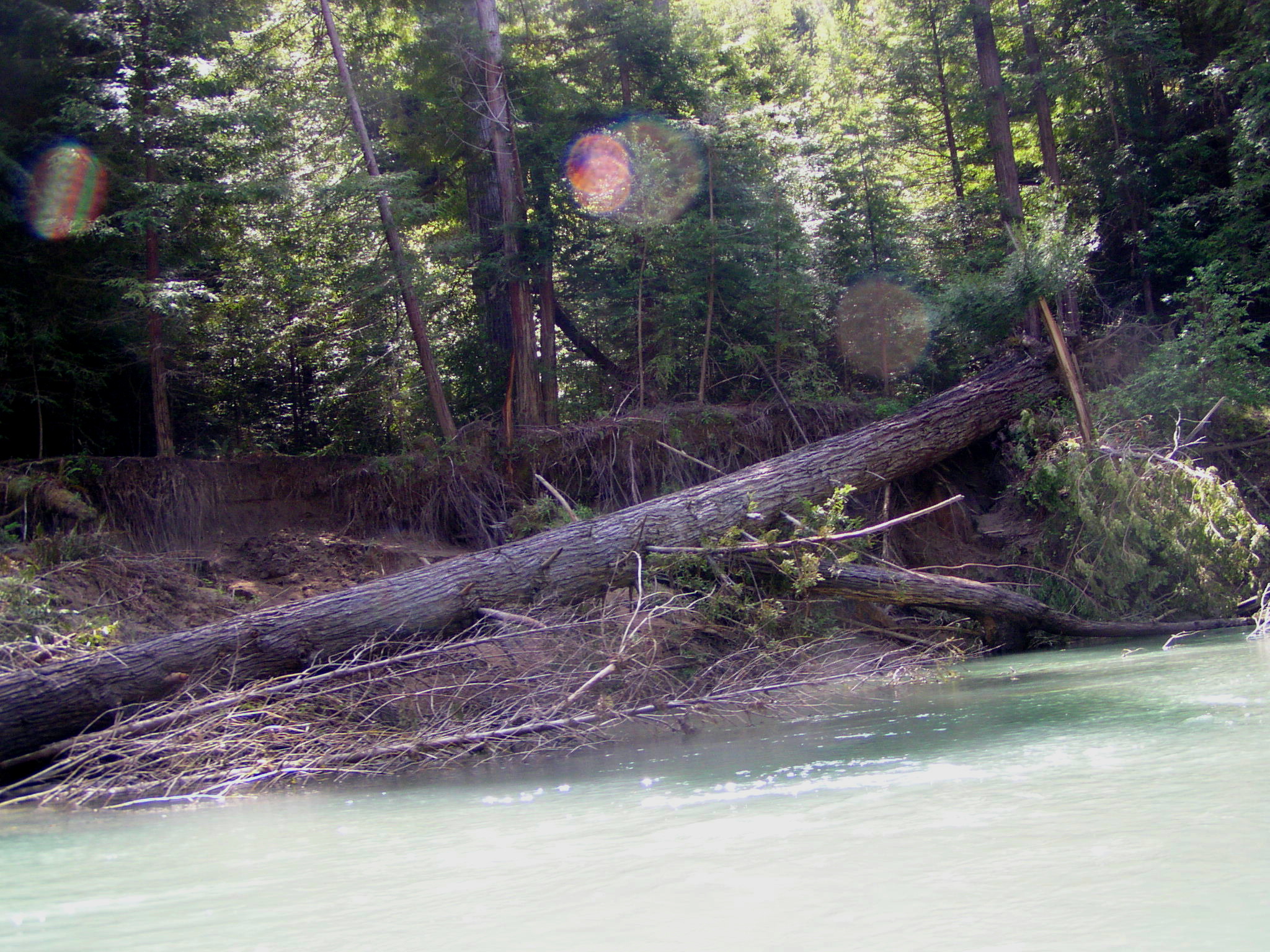
Speaking of redwoods, there were several giants undercut by the high water this year. One old giant was carried by the current far from its hole in the bank. Again we were lucky, there were no complete blockages. When the river was high, the downed trees were swept clear of the banks by the current and we could float past them without fear, although it is awesome to float past a reclining log 20 feet high. In one place a redwood tree had fallen and diverted the river so that it further carved out the bank and undercut several smaller trees that fell in a tangle into the hole. While the river was high it had cut a hole in the bank big enough to fit my house (2 stories with big living, dining and kitchen rooms). Needless to say the water was cloudy.

river bank cut away by downed tree

The only redwood that posed a serious problem was laying in the current so that the river piled up on it and also went under it. But it lay parallel to the current and if you were careful you could avoid trouble.

Picture Charlie and I pulling the canoe through a gravel bed because we took a narrow chute to the left instead of going right like our leader suggested. Bill chose the right because that was where all the water was going but the path was narrowed by the large fallen redwood tree. The rest of the boats were clustered at the top, waiting patiently for their turn to thread the needle past the tree. Charlie and I went exploring a side chute instead of waiting. When the water thinned out, we climbed out of the boat and started pulling on the bow painter with all our weight. A little voice in my head said that it wasn’t a good idea for both of us to be pulling on the same rope but I couldn’t remember why, so I didn’t change my position. At one end of the rope, there was the heavy boat, unwilling to budge. Charlie lurched to the right and I lurched to the left, cocking the rope like a slingshot. I was the pebble. My feet cleared the ground when Charlie threw all his weight and muscle against the rope. I landed on my back in about three inches of freezing cold water-sodden gravel. My fall was cushioned by the gravel and my pfd, and thank goodness I didn’t land on anything big, but I was stunned, wondering what the Heck happened! It took a while for the instant replay to reveal how I ended up in the water. Charlie helped me up, wondering why I was lying there in the first place. I was cold, wet and achy for the rest of the day. When we got to camp I broke all the POST protocols about helping get the kitchen set up before taking care of my personal gear. I took an Aleve, set up my tent, changed into dry clothes, inflated my mattress, and snuggled into my sleeping bag and almost, but not quite, fell asleep.

While I was snug as a bug in a rug, wood was gathered for a fire, and dinner was prepared. The appetizers were almost gone. Then we ate Bill’s Sloppy Joe’s with bagels with carrots and snap peas on the side. There were about 10 different cookies and brownies for dessert.

We sat around the fire until three stars were peeking out of the gradually clotting fog. It was getting too cold for the fire to help unless we really piled on the wood and since it didn’t look like we were going to stay up much later we let it die back.

Taking a nap in the evening leaves me awake at some ungodly hour of the morning. I think I woke up for good at 3:30 AM and drifted in and out of sleep until 6, when I heard stirrings in the kitchen. I heard Charlie, who sleeps in his clothes, staggered down the beach in search of the groover. I put on my wind proof layer and crunched over to the kitchen. Bill had started a cheery fire which was just flaring up a neat pyramid of small branches. As I came within hearing distance he said, “No match.” I bumped his shoulder in congratulations.

“Cool. What did you use?” I asked.

“ Flint. I was going to use matches but I couldn’t find them in all the kitchen stuff so I thought I would give it a try.” There is such a fine feeling from a small moment of success.

I was on breakfast duty but I thought I would wait until it was light out to start cooking.

One year when I was organizing the Memorial Day trip I accidentally organized a pot luck that included two Sunday night desserts and I brought pound cake and frozen berries for a strawberry shortcake. The other dessert was more perishable than mine so we ate that after dinner and I prepared the strawberry shortcake for breakfast on Monday. It was such a big hit with the campers that I decided to repeat the performance on the Navarro.

One really nice thing about this breakfast is that it doesn’t require any cooking. You can boil all the water you need for coffee and instant oatmeal. As a concession to the cold morning I put all the frozen berries and cherries in a pot and heated the fruit before serving. Breakfast was ready in minutes. I included bagels, cream cheese and instant oatmeal, OJ, milk and 3/4 pound of coffee, Hot chocolate and a tea bag or two.

Jim and Barbara brought lunch.

Before we started packing up, Vince demonstrated a neat tool. It was a long Mylar bag, maybe 10 feet long. It was open at one end and had a valve at the other. He grabbed the bag by the open end and flapped the bag until it filled with air. He quickly grabbed the open end and twisted the bag closed, trapping air in the bag. He then told us that you could put the valve on your mattress and blow it up by compressing the bag! Wadded up, it fit in one hand. Here is a link to a website showing it. http://www.themillair.com/

We loaded the boats and were on the river by 9:55, 5 minutes early.

The canyon widened out on the second day of paddling and the river slowed and flattened out (not that there were ever ANY rapids to speak of) and the willows started to dominate the channel. There were places that made me feel like we were tooling though a swamp. The challenge was to wind carefully through the brush and keep from knocking surprised spiders into the boats.

The take out was hard and steep and rushed. Gear was distributed, then hugs goodbye, then people loaded into the vehicles and engines flared. It was over except for the drive home.

Another perfect trip. Thanks Bill and Mary and everyone who came on the trip. I couldn’t have enjoyed it without you.

Bill and Mary, still married after all these years.

EEL, SOUTH FORK February 18-20, 2011

Near Garberville, CA

Sunshine & Rain…bows

Links to photos:http://www.flickr.com/photos/barbara-james/sets/72157626103871708/

by Eric Rasmussen
Usually, this President’s Day trip is soggy. “Cold and wet” is the enticing description on the POST schedule – can’t fault this club for false advertising. With such offerings is it surprising that our membership isn’t mushrooming? Yet three new members came on this outing. In his “is there room?” e-mail David S. wrote “I have no aversion to being cold and wet.” It makes me proud that people apply for our trips as though interviewing for the Marines, or Lewis & Clarke’s Corps of Discovery. And for this trip, coming as it did after the wettest and coldest week of the season, signing up was a true act of courage, or something less commendable that we winter paddlers have in abundance.

If you’re reading this and thinking what fools we are, you’re not alone. On our way up, shortly after Vince and I merged back on 101 in Santa Rosa with David just into the back seat, David watched another driver pass us. The driver looked at the two canoes on the rack, at the stormy sky above, at us, and then crossed himself.

As it turned out, the weathermen (NOAA) who convinced Don and I to not cancel this trip were right. It was sunny on Saturday – part of the way up and on the Eel. But not back home in the Bay Area! Yep, all you wusses who didn’t dare to join us: we paddled in sunshine. Even while the rain was falling on us we saw sunshine. And rainbows – the end of one was right at Tooby Park, our Saturday take out. Guess we know who Gods chosen people really are.

When Vince, David and I reached the Richardson Grove State Park campground, just south of Garberville and the Benbow Inn, cars and trucks under canoes were on both sides of the drive. Don and Karen, Bob and Joan, Pat and Eileen, Jim and Barbara were already there. It was about 10:45 – 11 was the designated arrival time. Ours, the kitchen site, number 48, already had the stove and several boxes on the table and a tarp stretched tautly over it. We pulled in, unloaded, and started setting up our tents. It was clear and dry now, but “cold and wet” were expected. Several people asked if anybody else was due. Yes, Alan and Kate. No, they hadn’t called to cancel. And soon they arrived.

In short order all vehicles and boats were at the campground beach and we prepared to send all drivers on the shuttle to Tooby Park. We all scanned the river. It was bigger and faster than we’d ever seen it. How amazing that only a week or two before, people worried we couldn’t paddle because there was too little water – only about 200cfs (cubic feet per second). Now we were looking at 15 times that much. Don decided that on this trip we wouldn’t do our usual Leggett run which has the class II rapids and at this heavy flow would be dangerous, especially for our new members. So we’d keep to Class I. But even this concerned me, for my partner David not only hadn’t paddled for decades; he outweighs me by eighty pounds. I had some troubling thoughts about what might happen if David, already making the bow a pivot point with his size, used his strength inaccurately. I’d decided that we needed to get to know each other as paddlers – before we met up with a fallen tree or brushy turn.

So using the shuttle time as a warm-up period we got into the boat and paddled upstream in the near eddy. No doubt about David’s strength. Our big Dagger Legend moved smoothly, even if the bow was much closer to the water than the stern. We also successfully back-paddled, a useful skill when trying to avoid obstacles). And then, remembering my original POST classes on Lafayette reservoir, I asked David to do sweeps and draws to help us do circles with the big boat. Now confident that we could do basic maneuvers, I steered our canoe out into the current and found that we could ferry well, easily holding our position on the river while going back and forth across it. Great! We were warmed up, and happily headed downstream after leader Bob.

It was now after noon, but true to tradition, no lunches had been eaten. I was ready for mine, though, and watched with some dismay as Bob continued to lead us through turn after turn. I’d hoped two bends in the river would be enough but no doubt he was waiting for a beach with an actual eddy to safely pull into. Only a few stomach grumbles later he found it. Ahh.

There were two expected excitements before the Tooby take-out. The first was “low bridge”, a cement roadway that at low flows clears the river by a couple of feet. Last year Carol surveyed it and led us under the far right side. Nobody expected such clearance this year, and, sure enough, a lone paddle would have snagged on the roof of the bridge. So Bob led us to land on a gravel bar in the middle of the river, and from there we teamed up to lift and carry all boats across the bridge.

When we got in sight of the historic Benbow Inn, Don & Karen announced that they were going to take out. Don was experiencing the vertigo that sometimes afflicts him. We all helped move their boats to a safe place above the beach, and encouraged them to enjoy some drinks in the bar. We also promised to swing by and pick them up on our way back to camp.

Then came the dam at Benbow. This is a real dam – a substantial cement wedge that spans the river to create a reservoir for the lodge. In its center is a closable opening about 15 feet across. In the summer this is filled with timbers, but in this season the opening is clear. On most trips we simply paddle through it, but on Saturday Bob waved us to take out on the far left. We all eagerly climbed up on the dam and walked to the edge of the gap – and gasped. The entire 3000 cfs was crashing through that narrow gap. It wasn’t quiet, and it wasn’t smooth. Just below the opening was a monstrous wave.

“I’d run it if it was 20 degrees warmer,” declared one smart paddler. Yes, it looked like fun. Chances of tipping were about 100%, but there wasn’t a boulder garden to bang through below. What there was though, was very cold water, and very little daylight left. Instant and persisting “wet & cold” would be the reward for that passage. Nobody took it.

Instead we all worked together to lower ourselves and our boats down the short but steep left front of the dam, then lined the boats through the big, powerful eddy to rejoin the river 50 or so yards downstream. The operation was time-consuming, but successfully safe. Once again POST practices insured that our risks were calculated and carefully taken.

Some rain fell Saturday afternoon, but often sun could be seen even during the rain. There was one section where we were paddling toward the sun as steady rain fell. Every drop was backlit and glistened. It was like paddling into a downpour of pearls. But softer.

Near Tooby the precipitation gave us two more treats. The peaks visible in the distance were covered with snow. And just ahead, a rainbow arched overhead. As we passed under the bridge just before the takeout, the rainbow touched down – just beyond the park. Taking out was our pot of gold.

Since most of us had put up our tents before paddling, once back at camp there was an immediate interest in food. Fortunately Bob & Joan had each made and brought a lovely multi-layered dip. These became the center of the conviviality that is only possible when you and your few companions are alone in the midst of a great forest, and have just exchanged cold and wet river clothes for warm, dry and loose-fitting garb.

After a shortish while, the happy, relaxing campers realized that if they wanted a main course, they’d have to work for it. The organizer(whose name and mine are the same) of this trip, unlike Bob and Joan, is not especially well-organized, and is relieved if he can simply get to the campground with all the ingredients for the meals. Turning those raw materials into cuisine is up to the diners themselves. And, tho by the time it was ready, they themselves were nearly undone, the volunteers succeeded. And declared their work delicious. The sautéed chicken in sauce on brown rice and big green salad hit our spots.

Next day the organizer decided that the best route to take, since the dangerous, fun Leggett run was out, was the scenic choice – the world famous Avenue of the Giants. This promised adventure, too – right from the start, since nobody knew exactly where to put-in. Or take out. Though he needed to return, and therefore not paddle, on Sunday, Don offered to do the shuttle. And help determine the necessary ins and outs. He got us started at the upper end of Phillipsville, from a private beach that the owner leaves open for public access. Then he went with the drivers who parked their cars at a day use park just beyond Myers Flat. When all returned in Don’s car, the day’s paddling began.

Not too far along we came upon a freshly sheared left bank. Overhanging the vertical brown wall were the roots of still standing redwoods. And laying in the river were dozens of fallen, but still green trees. A number of other redwoods had been carried off by the high water and we saw them snagged near the shore in several places downriver.

One of these large trees somehow got anchored well out in the river and David and I paid it a visit. I write this not to tell you how fascinating it is to touch the entire length of a redwood without climbing, but to warn you not to be as stupid as me. This tree was, of course, a strainer, one of the most dangerous threats to paddlers. Unlike a boulder that often forces the water to act like a cushion paddlers and prevent impact, this pinned tree did not stop the water from passing through its branches. Fortunately, it was positioned mostly parallel to the current, not across it, so our active paddling allowed us to stay along its edge, and we weren’t forced to save ourselves by climbing onto the tree and getting rescued. We got past without even taking in any water, but the incident frightened me, and demonstrated that strainers aren’t only in brushy banks. Next mid-river tree I see, I’ll not wait to touch it, before paddling hard on a course that clears it.

Apart from this near misadventure, the paddle was lovely, with the forest thick on either side. The weather was less attractive. Mostly gray. A last bright spot was at the take-out. A ranger arrived shortly after we did. Had we broken some rule? No, the officer only asked if we enjoyed our day and if we’d seen any snags or other risks to boaters. Mostly, he seemed glad to see that somebody was actually out here in this great park, enjoying themselves. Yep, that’s what we do.
Links to photos:http://www.flickr.com/photos/barbara-james/sets/72157626103871708/

Tuolumne/Stanislaus Rivers trip report, October 23-24

Tuolumne/Stan

October 23-24, 2010

Bob and Joan THANK YOU VERY MUCH FOR ALL YOUR WORK!!!!

Joan and Bob decided to reschedule the trip to an earlier date so that the weather would be better and there would be more light and to avoid daylight savings issues. So the trip went forward on October 23rd and 24th.

It was a small group of 14 and the weather was threatening but those 14 are the diehards of POST, Don and Karen, Kit and Charlie, Jan L. Eric R. Vince and Shauna, Pat and Eileen, and just to round things off our friends from Australia, Sherman and Tallulah. Then Bob and Joan made 14.

Another change to the plan was the campground. Turlock Lake SRA has changed its fee structure to $30 per campsite including 1 car. An extra Car is an additional $10 (1 extra per site) and then all other cars are $20. Since this is usually a car intensive trip, the cost of the campsites and parking was going to cruise past the $200 mark and Joan and Bob thought that was outrageous and shopped around for another campground. They found McHenry campground near Oakdale. Don’t bother to Google it, you won’t find it. It is part of a string of campgrounds along the Stanislaus called the String of Pearls. They are boat access only and even though we weren’t actually boating into the campground we were boating on the Stan so we qualified for a big site not too far from the parking lot. When Bob registered for the site they told him that it had been used for camping less than five times in the last season!!! Note: I would guess that the lack of advertising and Google presence might be a significant contributor to this becoming an underused resource.

There was lots of space in an area that had once been a walnut grove and there were also giant eucalyptus trees. We had the campground to ourselves. On the way to camp in the POST van we experienced a little bit of rain but by the time we got to McHenry it had stopped. We set up our tents and the kitchen tarps and headed off to the put in at Knight’s Ferry. I guess the worst thing I could say about the site was the ground was covered in walnuts and undermined with gopher holes and tunnels. Which isn’t a real complaint, trust me on that. It was easy enough to clear the nuts from where I wanted to put my tent. I also set up a square tarp overlapping my vestibule so we would have a dry place to  put our boating gear and wet clothes when we got back to camp in the evening.

There weren’t any showers (unless you count an outdoor cold water rinse near the parking lot) but in the bathrooms there was a little treat: Hot air blowers. I don’t know if you have come across the new generation of hot air hand driers but they blow with enough force to knock down small children. The water blows off instead of evaporating. Hummm, I thought, Interesting. Never one to limit my use of a thing if I can find another unintended use for it, I opened my rain coveralls and blew the interior dry and warm, the hot air billowed out the pants all the way to the floor. Later Eric mentioned that he used it to dry his tooth brush.

Obedient Rain

Weather was an interesting subject for all concerned. The weather reports gave us a 40% chance of rain during the day and a 75% chance on Saturday night, but the temperatures were comfortably high all through the weekend. Every time we got in the van there was a brief sprinkle but when we were on the river it was dry. On Saturday night when we got to camp it started to rain pretty hard but there was plenty of room under the various rain tarps so the kitchen crew was able to fix dinner (excellent, excellent food, Bob and Joan!) and the rest of us either sat at a dry picnic table or in the ring of chairs set up under a third tarp. After dinner and clean up, we had dry clothes and water-proof tents to snuggle up in when the sky fell in torrents.

During the night there was a crash of pots from the kitchen. I suspected raccoons. I am the kind of person who will lay in bed waiting for the next crash for hours. Each little thump or whisper will announce destruction in camp so I surrendered early and pulled on my rain gear (second set) and went out to investigate. The kitchen tarp had filled with water and collapsed under the weight. I pulled the tarp over the stove and other equipment and went to our tent. I took off my wet gear under the “vestibule” of my tent but it was quite a struggle, especially the rain pants because I couldn’t straighten my legs. I settled on pulling them down around my knees, opening the door so I could sit on my mattress and leaving my legs and sandals in the vestibule. To keep my sleeping bag and jammies dry I left all the wet stuff in the vestibule. All the while I was imagining what I would be doing on a wilderness trip with only one set of dry fleece jammies and rain gear. In the morning the rain had stopped and we had pancakes and sausage and other goodies before we broke camp.

The wind on the other hand never let up. It was roaring through the walnut and eucalyptus trees sounding like a runaway train on a long down hill grade.

After the constant rain Saturday night and the even louder wind in camp Sunday morning the thought of driving to the Tuolumne which had lower flows and a wider flood plain and an unpracticed take-out further downstream from the usual spot, I suggested to Joan that I wouldn’t object to doing the Stan again. She took it to the rest of the breakfast eaters and it was voted down but later re-emerged as a done deal.

On the river it was howling high above the water in the tops of the trees but it didn’t seem to reach the boats! There were occasional gusts that you could see ruffling the water as they rushed at you, but they always seemed to dissipate before they knocked you over. It was noisy but didn’t slow us down one iota and the sky was dry except for occasional individual drops of rain. I mean you could probably count how many drops came down while we were on the water.

So Sunday, we went back to the Stan so that Sherman and Charlie could flip their boat in Russian rapid.

Going back to Saturday at the put in; we were pleased to see that the Stan was running about 3 feet higher than what we are used to.

According to the gauge at Orange Blossom it was running at 1150 cfs on Saturday, spiked up to 1175 at midnight and then took a plunge to 1100 by noon on Sunday. Normal flow is about 350 cfs. That meant Russian Rapid was likely to be washed out into a long wave train and not too difficult.

My partner was Tallulah, our friend from Australia, and Charlie was paddling with Sherman, her father. The last time Tallulah had paddled was when she and I paddled the Smith River in July of 2006, I don’t remember when Sherman paddled last, but I am pretty sure it was before that. Tallulah and I did a few practice ferries and peel outs and it all came back to her, her strokes were strong and effective. I chortled at her that we were going to have lots of fun. We headed downstream. The original plan was to meet Bob at the ledge at the top of Russian Rapid, where he would help pull the boats out of the way so everyone could scout the rapid. But, as the ledge at the top of the rapid was under water, Bob struggled back upstream to meet us at the top of the portage trail which was running at about 100 cfs. Yep, the river was flowing down the path deep enough to paddle the boats except when the brush got too catchy.

Charlie and Sherman took the portage and Tallulah and I took the rapid. It was so much larger than I have ever seen it. Whoopee! We paddled down the left, through a nice chute, back paddled to the right to line up another chute, then aimed very close to an overhanging willow branch on the left, and then hit the big wave at enough angle to test my brace and lean, but not so much as to flip us. Then we plowed through the wave train which was surprisingly powerful with up and down as well as lots of swirlies that threatened our balance. Bob had suggested taking a shot at the eddy on the left, where the portage trail ended, but we were long past it by the time we stopped struggling with the wave train so we pulled out on the right, next to Don and Karen. Then we watched the other boats come down. No one flipped. Some people were able to catch the left side eddy others came to our side, the voyageurs straggled to the end of the portage, their boats full of small brush and leaves.

It took a while to regroup on the shore for lunch because the wave train pretty effectively separated the two beaches. Jon D. had elected to paddle his IK solo so his partner could walk the portage (I swear he was almost airborne when he hit the wave train) but he ended up on the wrong side of the river from his partner and lost a lot of ground ferrying over to join her. There was lots of hand waving and shouting over the roar of the water but eventually we were all on the same side where we ate lunch and watched the river. No one elected to carry their boat back up the right-hand shore to run it again. Perhaps people were thinking that they didn’t want to risk a swim when the weather was so threatening.

After lunch we toddled off down the river at a fast clip. Tallulah and I were near the front so we got to see a giant Blue Heron taking off like a B-52 and a quick view of an otter in a pool. We collected some trash from the shore and coasted at what seemed like 20 mph compared to our normal 3 mph. We arrived at the Horseshoe Bend stretch break at about 1:20 PM so Bob volunteered to take the shuttle vehicle to Orange Blossom Bridge so we could go the extra 3 miles past Horseshoe Bend.

Then we returned to camp via some interesting wanderings in Oakdale, where the street signs leading back to camp didn’t match what they said when we left in the morning.(IE Santa Fe turned into First Street without our noticing it on the way out, when we came to First St on the way back, it was new territory to us. We drove another two blocks and came to turn left on Santa Fe, which dead-ended about three blocks off the main drag. We circled around the block, passed another car from our group which was headed in the opposite direction and indulged in a bit of Keystone Kops until we figured out the First Street/Santa Fe kafuffle.)

On Sunday we arrived at Knight’s Ferry, loaded the boats and paddled down to Russian Rapid. The flow was ever so slightly lower than Saturday so that when Tallulah and I hit the diagonal wave it was steeper and thinner. We shipped a lot of water  from the bow, then took on more water as we wobbled through the rest of the wave train. Just as we cleared the wave train, whistles went up and we looked back to see Charlie and Sherman swimming through the big wave and get doused a few times as they swam the wave train. Sherman did not look happy. We were so full of water that we were unable to help with the rescue. Multiple small boats rushed to the rescue and Sherman and Charlie got pushed into a beachless eddy below the lunch spot, the flipped boat had cracked into something hard on the way down and above the water line the stern was crunched. We will need a work party to fix that one.

We regrouped on a gravel bar downstream of Russian Rapid and everyone clustered around Sherman, handing him dry clothes and fussing and pretty much forcing him  to strip off his wet top layer and put on some dry clothes. He protested that he wasn’t cold but more cautious heads prevailed and he looked a lot more comfortable after he changed. Charlie did his own striptease without so much attention.

We motored down the river at what seemed like a faster pace than Saturday’s run. Saw some goats who had denuded the shore near their yard.

We arrived at Orange Blossom just in time for the rain to start as we finished loading the van and trailer. Unfortunately I missed some of the goodbye hugs because I was in the bathroom changing into dry clothes when the other vehicles left.

I wanted to give Bob an especially big hug for providing such a great feast for us all and all his trip preparations, finding such a great campground and organizing the herd of cats called POST.

The drive home in the heavy rain was quite a thrill. It was pretty dry by the time we arrived at the POST storage facility in Oakland, where we unloaded some gear and the trailer. We returned to El Cerrito to pick up our cars and that was that!

Swimming Another Rapid, Trinity River 8/10

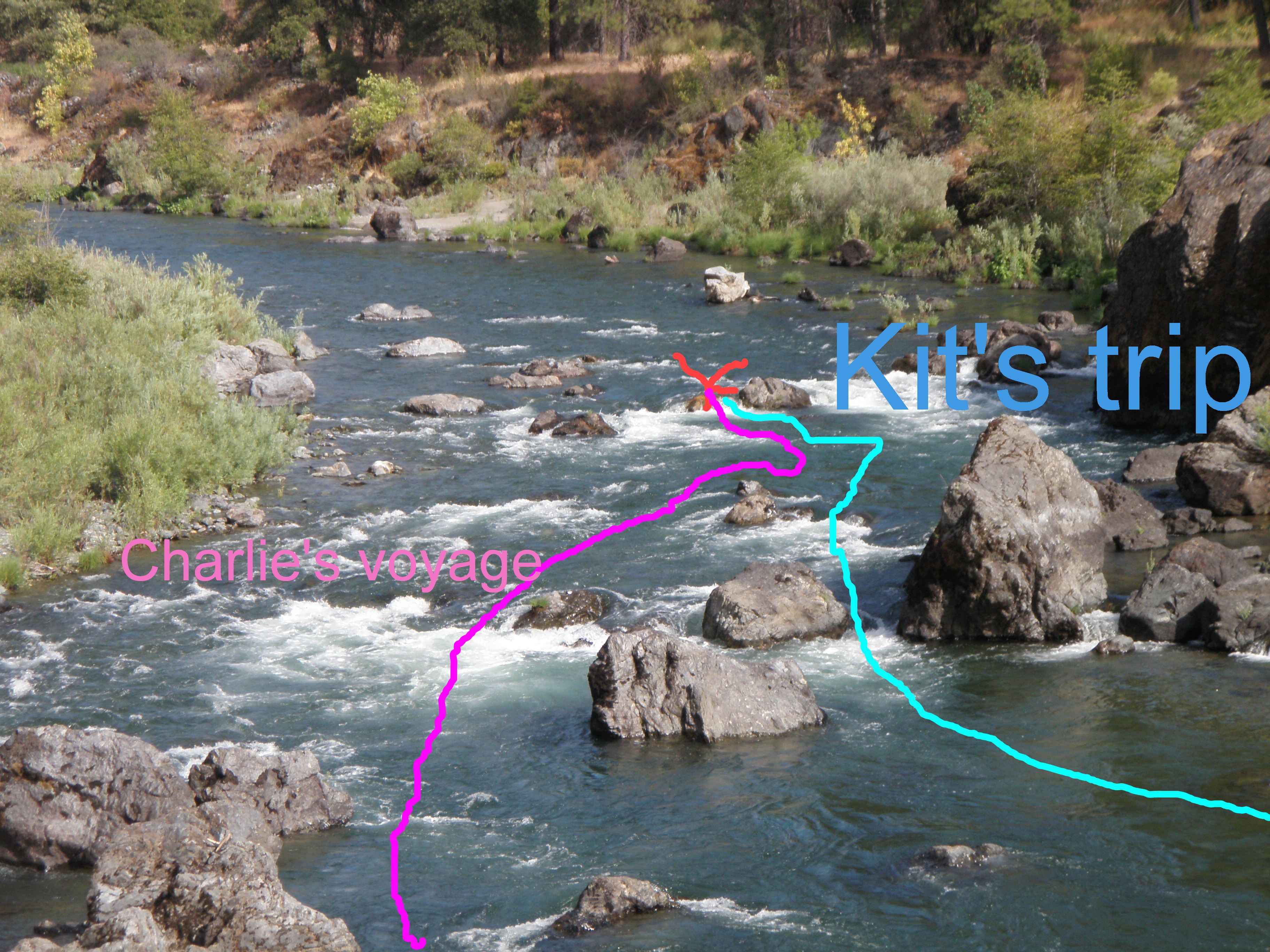
our routes
cable car rapid, trinity river 2010

Cable Car Rapid, Trinity River, CA

(3800 words)

Eric, our trip leader, asked, “How far do you want to go? We can take out at French Bar or Del Loma.”

“What’s the difference?” I asked.

“For a start, Del Loma is further downstream.”

“Ha, ha. — How far?”

“Not too far, but there is a Class III just below French Creek.”

The rapid I was really worried about was Cable Car Rapid, roaring a scant 200 yards downstream of our put in.

This year the water was low and the chicken route was obstructed by barely submerged rocks. We were going to have to take the more complicated and daring way, a way I wasn’t at all sure of for many reasons, the most obvious being that I knew I could pick my way down the chicken route, having done that many times, but I have ignored the harder route because I never needed to know it. I answered Eric’s question with a tilt of my head in the rapid’s direction.

“Cable Car’s enough, I think. Let’s take out at French Bar. Do we have time to inflate our flotation before the shuttle?” Once the shuttle was done things tended to happen quickly.

“No there’s no rush, you guys get your boat ready and then we’ll go.”

I started pulling things out of the back of the car; my mesh bag, my husband Charlie’s mesh bag, the bright purple bag with our flotation and thigh straps, our water bottles and bailers. They all got dumped near the front of the car. By the time I was done Charlie had lifted the hood and hooked up the air pump to the battery. Eric and Pam and Olson were standing on the shore looking at the river. They live in the neighborhood; they don’t have to break down their outfitting every time they go boating. Feeling behind already, I rushed to tie our air bags into the web of lines in the bow and stern of our boat, and bent awkwardly over them with the pump. When the bags were full of air I tested the lines, they made a nice deep thump as I plucked them. I remembered Bill, my boating papa saying to me, “Tie everything in as if the boat was going through a washing machine.”

The guys took off to run the shuttle, which was going to take about half an hour. Then I had time to get really nervous. Any time a married couple gets into a tandem canoe, people start teasing them, calling their boat, “The Divorce Boat.” Couples who live together really KNOW how to let ‘er rip when it comes to recriminations. Imagine a car with two sets of brakes and gas pedals and two steering wheels and both drivers have to work together to merge onto the busy freeway or zigzag into a parking space. It doesn’t take long for most couples to decide to get solo craft.

But, on a good day, I love the tango of tandem canoeing and the option of going solo has never been attractive to me even though my dread of blowing it with my husband has left me seriously considering duck taping my mouth shut. The only reason I don’t is because I am afraid of suffocating. At the beginning of every trip there is a grinding worry in my chest that my husband will stop forgiving me for my rages. That he will snap back and one of us will say something unforgivable. Some days we are better people than others. Adding to my angst was the not-so-distant roaring of the rapid downstream. I was getting queasy. I tried to stop thinking but still had vivid flashbacks of times when I wanted to smack him in the head with my paddle. There are more than the usual safety reasons we wear helmets in a tandem.

I started polishing off the details of outfitting our boat. I put my life jacket and helmet on the seat with my paddle so I would remember to put them on. I tied our spare paddle under the thwarts. I checked the knee pads. I tied my dry bag to a D-ring glued to the bottom of the boat and added a little rope leash with carabiners to the D-ring to hold my water bottle and bailer handy and out of the way.  My drybag carried a spare set of warm clothes, a first aid kit and a large roll of duck tape for boat repairs. I started to tie in Charlie’s gear then stopped. Ongoing issue: he doesn’t like me messing with his stuff. Then I saw that both of the other paddlers were bored, staring across the river, waiting for the cars, while I was still frantically putting things in, snapping carabiners, tying gear down, untying it to put it in a better spot. I was starting to drip sweat from the tip of my nose. I forgot my spare set of keys and had to trot back to the campsite to find them and when I got back the car was back with the drivers. A family of teenage boys was hauling a bubblegum-pink raft down the boat ramp and our boats were in the way. We started rushing to get onto the water. As we drifted into the current I was unstrapping my dry bag, unrolling the opening, wrapping my keys in my sweater, rolling the bag back up and tying it back into the bottom of the boat. I was done even if I wasn’t done. I had to stop fiddling sometime. I took a deep breath.

Our boat, a Caper, is shaped like a light blue 15 foot long banana with the inner curve peeled away and scooped out from bow to stern. Like a banana it is also curved from side to side. This makes it an excellent whitewater play boat, quick and maneuverable, it will turn on a dime. It will do exactly what you tell it to do unless it is already doing exactly what the river has told it to do. Being in the right place is essential with this boat. All this curviness also makes it less stable than a traditional flat-bottomed lake boat. Another thing about the Caper is that the seats are very close to each other in the middle of the boat. I sit about 4 feet from the bow of the boat. Behind me there is room for a waterproof lunch box between us and then Charlie’s knees on kneepads with a low-slung thigh strap. After 18 years of teaching canoeing and taking beginners down the river, I have gotten habituated to paddling stern but in the Caper, Charlie is so close that I can’t see over him, so I sit in front where I feel I don’t belong.

Within seconds of getting into the boat, my heart was thumping. We paddled out into the pool by the boat ramp and tried a forward ferry across the river. I could feel that Charlie was having trouble balancing himself in the boat. I am tuned to feeling the boat tremble and lean as he shifts and tries to keep his balance. He usually settles down after a half hour or so, but the Big Bad Rapid was coming at the start and he wasn’t going to have time to wiggle around, relax and get comfortable before we were challenged.

After a few clumsy maneuvers, we pushed into the current, following Eric and Pam in their tandem and Olson in his solo.

As we approached the rapid, Eric signaled that we should catch up with him. He pointed to the left, “We’ll pull over in that eddy on the left while you scout on the right. You go up there,” he pointed to a rocky slope on the right hand shoreline. “When you get into position, we’ll go down so you can see what route we take.” He paddled off to the left and Olson and Charlie and I went right and pulled into a small eddy, tied up the boats and started climbing through the rocks and dry stickers to get to a spot clear of willows and brush so we could see the water.

I followed Charlie on the shore, while Eric and Pam waited for us on the opposite shore. When we looked like we were settled and ready to watch they started down, back-paddling and side-slipping to get into proper position.

Cable Car rapid drops down 3 ledges like a staircase that has been broken up in random places. The first step or ledge is made of large rocks, the parts above water being about the size of a couple of easy chairs and a loveseat. There is a gap on the left that collects most of the water which dumps over a 12 to 18 inch drop. Near the rock is a nice green chute leading past a small hole foaming with air. The farther the water falls and with more force, the bigger the hole. Because of the airiness, you don’t float, even when you have on a life jacket. You can also lose control of your boat in a hole because the current is whipping around in a gazillion directions and can wrench the boat off course, fill it with water and flip it over. It was a bit disconcerting to have a hole at the top of this rapid but this first little chute was the route of choice because it was the only place with enough water, the rest of the approach and the ledge being a tangle of obstructions.

Eric and Pam floated between some rocks at the top before we were really focused on them but we watched them slide into a place where the water temporarily smoothed out below the first ledge. They took the slow water to a chute on the right, neatly skirting a big boulder a bit left of the center. We kept staring at the noisy, rock-filled drop and its attendant holes. The last ledge has the biggest drop and most of the water on the right side funnels through two narrow slots between car-sized boulders and their holes. They slipped to the left again and passed between an exposed boulder and a submerged one, right of center.  They made it look simple. They ferried over to a small beach on river left to watch us. Olson turned and headed back to his boat and started down before we got into ours so we missed his run.

Neither of us had paddled Class III for months. We stared at the noisy holes and pointed at the green tongues we should aim for and we discussed and pointed and debated and made ourselves very nervous. It all felt hypothetical since we knew that once we were at the top of the rapid we would be seeing a totally different river. Imagine trying to read a book looking at the pages from the edge instead of laid flat out in front of you. When you get involved with a drop, you are on your own and there is no time to stop and say, “Were we going to take this chute or the one next to it?” It all looks like a brand new world.

I tend to paddle towards whatever I am looking at. On a good day that means I am looking at the safe chute that is clear of rocks, on a bad day that means I am staring and thereby heading straight towards, the big noisy foaming pile of water and rocks that I should be avoiding. So, maybe that is why, by the time Charlie and I had climbed into the Caper and approached the top of the rapid, we were in the wrong place. We were drifting slowly into a slot that had no exit. I heard my voice yelling at Charlie, “No, we can’t go this way! Back paddle!” Unfortunately we were committed; the current was too strong to fight. The bow suddenly swept right and the stern left and the boat hung sideways for an agonizing moment and then slid into a rock broadside. My inner voice was yelling at the already doomed boat, “OH NO don’t’ wrap canoe, please don’t wrap around the rock, we’ll never get you off!” My imagination flashed the image of the distant shore and tried to imagine a throw rope reaching the boat, wrapped on the rock in mid-stream, nope that wasn’t going to happen.  This flash doesn’t take any time and I am back in the boat while I am flung to the side as we slide backwards off the rock into the hole behind it. We’re still upright! Maybe we can do the rapid backwards! I twist to my right to see where we are heading, but hope turns to dismay as the edge of the boat catches on the rock and water begins pouring over the side. I lean as hard as I can to the downstream side but the river outweighs me and I can’t even reach the water with my paddle to brace the boat. Then my face is heading for the foaming water and I better take a breath ‘cause I am going under.

All is water, movement and wet and cold and feeling myself pulling out of the thigh straps. My hand meets something hard and I instinctively shove at it, hoping to thrust myself away from it. It gives disconcertingly, then I feel that it is Charlie’s helmeted head. I float free of the boat and my head comes up almost immediately. Oh I hope I don’t ram into any rocks! I hope I don’t get squished between the boat and a rock. I look around to see a large eddy on river left. I wonder abstractly why it feels like I have cramps in both calves but I am still able to kick and so I forget about them. For the moment the water is deep and free of rocks. I hear Charlie asking, “Are you all right?” and I gasp out, “Yes! You?”  We are on opposite sides of the boat, we always end up on opposite sides of the boat, I don’t know why.

He answers, “I’m OK, I lost my paddle. I’ve got the boat.”

I see the boat’s bow rope floating nearby and I grab it. “I have the boat and my paddle.” This feels like a significant accomplishment. Charlie just repeats, “Yes. I lost my paddle.” And then, “Go for the eddy! River left!”  This turns out to be a futile effort as the current is sucking us down into the two bigger drops downstream and we are not able to fight the current. We speed up. It feels like we are in a flushing toilet as the river constricts between the rocks.

I hear someone downstream yelling, “Get your feet downstream!” The eddy is a lost cause. We have to get ready to swim the next drop. I have completely lost track of Charlie again and the boat is bumping up against a big rock, heading through a chute on the opposite side of the rock from me. As I accelerate I hang onto the rope, hoping I might drag the boat off the rock if it starts to wrap itself around the rock. The current is too strong and the rope slips out of my hands. It doesn’t even slow me down. I hear that voice yelling at me to keep my feet downstream. My body is in the right position but I have been spun so I am heading sideways over the ledge, I struggle around and just as I get my butt up and feet heading down I am sucked through and dropped into a hole. I am barely underwater long enough to experience a moment of dread that my feet might get caught between some rocks but I pop up, then enter another short period of calm water. Again, I have lost track of the boat and Charlie, and I am fearful that I will be battered by it and see that it is heading away from me, off to the right. Something good is happening but when I look to see where I am going, it does not look so good. I have been swept along on the far left and am heading for the worst hole of the rapid. The water is disappearing over a ledge. I can hear it roaring and see the foaming water flushing out the bottom and ramming into a truck sized boulder. In a fraction of a second I am going over the drop into the hole and I say to myself in an oddly distant way, “This is a good time to take a deep breath.” I suck air as deeply as I can just before my face is buried in the roaring, foaming water and I am upside down doing a back flip in the foam. Then I am up, blowing water out of my nose. There is a part of me that wants to curl up like a pillbug so none of my limbs can get caught in a rocky trap; I force myself to face what is coming and paddle with my hands to line up for the next thing, still trying to keep my feet and butt up. I have no idea what is going on. Charlie is 20 feet away, still in fast current but I can see Eric and Pam ferrying across the river to help him, he is still holding onto the Caper, yelling. “I lost my paddle.” He is angry with himself, wanting Eric and Pam to find his paddle more than help him get the boat out of the current.

I hear, “Rope!” and see Olson’s bright red and yellow throw-rope rattle out in front of me and I grab onto it and hold on as it swings me away from the big rock and into the shore. I know I should stay on my back with the rope over my shoulder but passively letting Olson reel me in is not an option; I absolutely have to see where I am going. He is braced against my weight and the pull of the river and I swing like a pendulum towards the shore until I can see the bottom as it comes up, full of sharp, dark-green rocks. I protect my knees while trying to get a hand on something stationary and still hold onto my paddle and the rescue rope. I roll into the shallow water and finally get a grip on something that stops my motion. Its an awkward business but I am finally landed, a superfish flopping on the bank. I am numb, so full of adrenaline that I can’t even feel my face or the cold water. I can barely hear anything but at the same time I can hear minute scraping sounds as Olson, standing quietly by, is stuffing his throw rope back into the rescue bag. He’s saying something, “You OK?”

I am breathless and start coughing up some water. I pat the top of my helmet although the coughing is threatening to turn into dry heaves. I really do not want to go there; I remember other swims that were made hugely more dramatic by sucking in a bit of water. The swim and rescue were easy but the coughing left me exhausted and weeping helplessly on the shore. This time the coughing is just a reminder and is over quickly.

Eric and Pam had retrieved Charlie’s paddle and pushed our upside-down boat into the eddy. Charlie is hidden on the other side of the boat, I hear him call out, “Are you OK?”

“Yes! You?” I yell and pat my head again even though he can’t see me. His paddle flies out from his side of the boat and lands with a clatter on the rocks.

“Yeah, I’m OK.” His voice is disgusted.

Then we get to work sorting things out. I am on the wrong side of the river from my boat, so Eric and Pam leave Charlie to deal with the over-turned boat and ferry over to pick me up. I am wary of sitting with my feet tangled in the rope that binds in their flotation so I sit on a thwart in the bow of their boat as they take me across the river. I don’t like being up so high, it makes the boat incredibly unstable and I have a quick fantasy of asking them to tow me across, but the current is strong and my body would drag them too far downstream to get back to the eddy. I examine Eric’s knees on the floor of the boat so that I can keep my balance. By the time we get to Charlie, he has flipped the canoe upright and is looking for damage; it had bumped hard three times on the way down but there was no damage. The flotation bags had done their job. I check for my dry bag and water bottle, they are still tied to the bottom of the boat. “Did we lose anything?” I ask.

Charlie replied, “Yes, my water bottle and bailer, did you tie them in?”

”I think so, I tied them to that bag.” I point to my TP bag which is still tied to the gunwale. “Oh, well. Maybe I didn’t tie it in. I have enough water for us both. I thought I tied it in??? Didn’t I tie it in?” The bag remains a silent witness to whether or not I tied anything to it. I am rattled and starting to crash off the adrenalin. Is he going to be mad at me?

“Its OK. I don’t drink a lot on the river.”         Then Charlie says, “What happened? I know you are going to say something.”

The way he says it is the red flag for the start of the usual recriminations and arguments after an accident. I don’t know why but for me the near-misses, where we narrowly escape trouble by skill or by accident, fill me with rage, but the complete loss of control in a flip just makes me grateful I am unhurt and not inclined to give into my lower self. “I don’t know. We went the wrong way and we couldn’t get us out of it. I’m sorry I pushed your head while you were under water.”

He laughed, “When did that happen? I didn’t even notice.”

After more mumbling and discussion we agree that we just got lost and it was no one’s fault.        I said, “Well, at least we got that out of the way.”

As we settled into the boat, adjusting our thigh straps and getting our balance Eric and Pam floated up. I said with a big smile, “That was refreshing.” There was still a bit of quaver in my throat but Eric, Pam and Olson all laughed. It was such a hot day we didn’t even bother changing into our dry clothes.

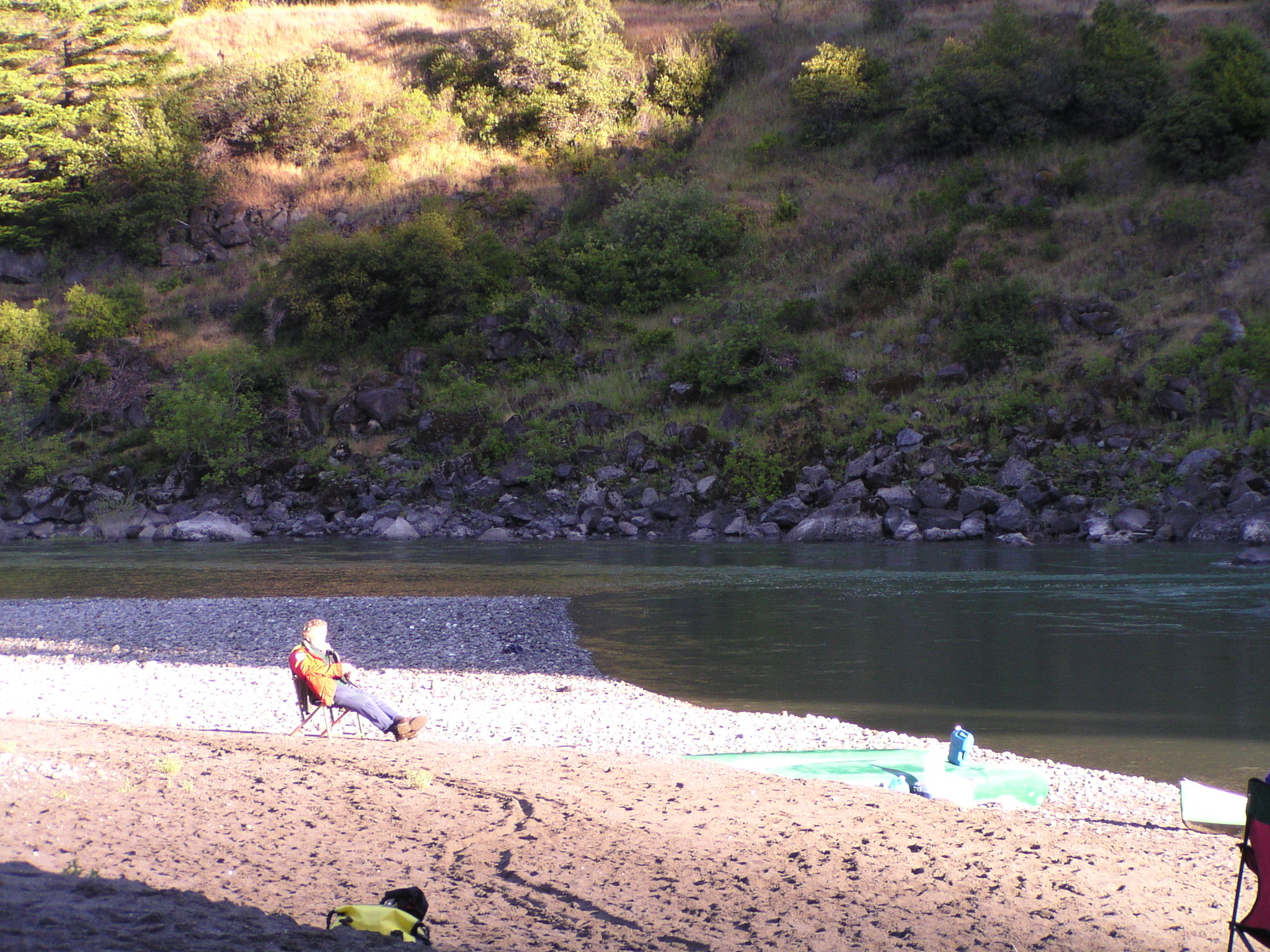
 

About Me

The canoe club that I am a member of is called POST. Not to be confused with Post or post, as in posting a blog entry or posting a poster on a wall (real or digital). POST stands for Popular Outdoor Sports Trips. I am going to move all the POST posts to a new blog called POST (or something like that) and keep this one for my own personal stuff. So I’ll keep you posted as to the progress and new name of the new blog. – Kit