Squirrels on the roof

In the past when describing my studio in the back yard I have mentioned that there is a lot of noise out there. The roof to my studio is made of opaque corrugated plastic that lets in a lot of nice light during the day but it is uninsulated and acts like a drum when things hit it. The wind knocks acorns and small branches out of the oak tree and when they hit the roof they sound like gunshots. Pow!

And sometimes the birds are up there scratching around looking for bugs in the detritus that collects.

And sometimes the squirrels have fights or at least they are playing chase up there. They make quite a racket racing across the thin membrane of the plastic.

I have mentioned to people that there is also a sound that sounds like a squirrel has fallen out of the tree onto the roof. This sounds like an explosion and very startling.

The idea that squirrels are falling out of the oak is met with skepticism.

Well, this morning, while I was drinking my coffee out on my deck, I was watching the sun brighten the day and there were a couple of squirrels playing chase in the oak. They circled the trunk and went out on the branches and in general behaved like squirrels do in mating season; lots of frantic activity.

Then, believe it or not, I saw a squirrel miss a branch. It was upright and its little arms were spread wide but it didn’t have enough momentum to make it to the branch it was aiming for and it seemed to hesitate at the top of its arc. Then it fell 15 feet straight down like Wile E. Coyote off the edge of a cliff. It did not land on the roof of the shed but I heard it hit the weeds on the ground next to it. I did not see or hear it after that.

I think it is safe to assume that squirrels are adapted to sometimes losing it – I have never found a wounded squirrel squashed in the weeds or a squirrel skeleton on the roof of the shed. They are frequent road-kill but I think cars are the danger in that case. And their lack of brains.

John says, “Write a Poem About the Sunset.”

Sunset
(After “Painting with John” HBO)

John says, “Write a poem about the sunset.”

The sun sets in the west.
red, orange, even a hint of purple.

Red sky at night – sailors’ delight
Red in the morning – sailors take warning.
Of course, now it is almost always red because of air pollution.

Close your eyes.
Listen to me.

The air is absolutely still
you can hear the grit and pebbles grinding under your shoes.

A totally blind person
will get it
without the light show.

The night critters
will take over from the
day critters.

The street lights will go on
the children will run home
sweaty and mosquito bitten
hungry and still wild.

A chill will grow in the
slightly spooky darkness.

I am tired of the past.
The stories bubbling to the surface
oatmeal burning in a pot on the stove
driftwood caught in a forever eddy
the Pacific Ocean garbage patches
stories told and re-told making the same point
from a different direction.
My mind drifting in circles.

Every sunset is new
every sunrise
there is no beginning nor end to the day
the clock is an illusion
time is an illusion
the earth spins effortlessly
the sun shines in the center
of our system
Each of its planets has sunrise and sunset
even though at the greater distances Sol
is just another star and night lasts forever.

John says, “Write a poem about the sunset.”
He is standing on a Caribbean Island hill overlooking the sea
and even with my large TV screen
the sunset he is enjoying looks kind of dull and distant.
It is clear to me that in that moment
he is feeling God-damned beautiful waiting for the light to fail
and the darkness overwhelm the sky
and the stars to shine.
He is writing the poem himself.

I face death every day.
When riding in a car I think about all the accidents that
DON’T
happen.
How interesting and miraculous it is that so few people die
considering how many people commute
down the same stretch of freeway
day after day after day.
You would think that more people would just decide that
ramming into the diverter was the best way to end their endless commute.

John says, “write a poem about the sunset.”
He back tracks on it later in the show and says that
he recognizes that it was unfair to ask me
to be able to get out a pen and start writing
about his sunset.
He was happy that night, looking at the sunset.
Good for you, John.
He’s something of a jerk but every once and a while…

He always gets pulled over by authority figures
TSA
cops
The Man.
So, he’s at the airport
the TSA agents always take him into a side room
they always go through his bags
they always frisk him.
He’s annoyed but after a lifetime of this he is patient
he doesn’t make things worse for himself by
adding fuel to their anxieties about
pulling people out of line and searching their stuff and frisking them.
But in telling the story I can hear the
bitter whining in his voice,
Always. Always. Always.
At some point my sympathies are lost.
He must project a certain assholeness that attracts
cops and TSA.
But let’s face it, he is a large man with wild hair, a beard, and a bent nose.
He looks like a criminal, an assassin in the movies.
In fact, he has played criminals in the movies.
Of course they worry about him.
Duh. What could he expect?
I start to tune him out.
I am getting ready to turn him off
But he keeps going with his story;

He finally gets on the plane and
nearby he sees a family
they’ve been through a lot
the man, his wife and 2 children.
The older child is a 10 year old girl.
She’s too big to be climbing all over her father
trying to get comfortable
she’s restless and anxious.
Nevertheless, the father is calm.
After much thrashing
the girl falls asleep in her father’s lap.
The sun comes in the window and falls on the daughter’s
face and the father holds his hand up
to shade her eyes.
For hours.
John forgives humanity
and that is when I forgive John for whining and being a jerk.

“Write a poem about the sunset.”
OK, John. I will.

The day can be hot or cold
dry or wet
but the sun will always set.

01-03-2024
Happy new year.

Highway 395

        One hundred and twelve miles
of road sways along 
or snaps straight its yellow lines 
pointing at the next ridge.
Four cars;
one old truck full of hay that unhesitatingly passes us at full speed,
one hugely oversized, chrome-splashed,
RV towing an SUV,
escorted by three fat motorcycles.
        And this:
We float over low hills laid like 
bare fingers 
across the soft palm of spring.
We zigzag up a knuckle then
wind down tree-lined, creek-fed valleys
in the web of the fingers.
Below us, each wide plain
something new and simple.
The tender, too thin, skin of the earth 
supports low flying clouds of yellow wildflowers
and islands of grey-green sage and olive coyote bush. 
Decayed wooden posts hold sagging, rusting, barbed wire.
They stand along the road like 
half stifled exclamation marks.
We pass through a cattle ranch;
acres uniformed in tall green grass 
rolling like a golf course 
or flat like a pool table, 
where shiny black cattle wade up to their chests
in food,
eight balls, scattered around after a good break.
The ornate gates leading 
from one pasture to another 
are tied open by climbing roses and matted weeds.
A vague band of mud clods and manure 
cross 395 to another open gate,
another pool table filled with invisible cows.
        The land, pale and distant,
blends into the pale blue, soft air.
Overhead, the sky is cobalt blue as if the atmosphere was so thin
satellites can look down on the line of highway
as if looking over the rim of a dry well.
        The clouds are a stage set.
They grow on the left and shrink on the right,
decked out to give the illusion of
perspective and depth.
        The clouds are the dust kicked up by the feet of 
a herd of horses once seen galloping West.
        Ahead, an alkaline lake. (Lake Abert)
An eye-burning white line thrust beyond a
tumble of dark red-brown rocks.
The water, a line between the white shores,
sharp and shiny as a shard of glass.
The high row of perfect white and grey puffs 
is mirrored there.
An abstract painting of silence and waiting.
A superlative reflected by a superlative.
        It could still be morning
The air is cool and clear and still.
A small bird whistles and flits 
from one low bush to another.
        I am the day on the edge of my seat.
I am the greedy eye, taking it, 
bringing it all home like a thief,
and leaving it in Oregon
permanent 
like a cloud.

Lake Shastina, February 2013

OLYMPUS DIGITAL CAMERAThe Mountain

My eyes are numb with sleep.
I struggle to understand the cold fog
of conversation coming from the distant kitchen;
something about coffee and eggs.

From the 20 foot high window, Mt. Shasta grabs me;
The mountain is golden, pink,
then lavender and cobalt,
then gray and black.
Everything is multiplied
in the black gloss of the lake below,
smudged by dull streaks of ice.

Snow crystals stripped off the top of the mountain
by silent, distant wind
catch the silver of sunrise,
form and faint at the mountain top
hoops of light and snow flying,
lace
or feathers,
a halo.

You know it’s cold up there,
the stubborn wind blasting the
snow skyward,
chaffing the mountain bare.

Sit in the warmth,
drink the coffee,
leave the ice in the camera for later.

Wild Geese

The wild geese on the island
walk up a rocky
slide into the black trees-
like old ladies clutching shopping bags
climbing the steep stairs of a bus,
complaining aaIMG_0211bout bum knees.


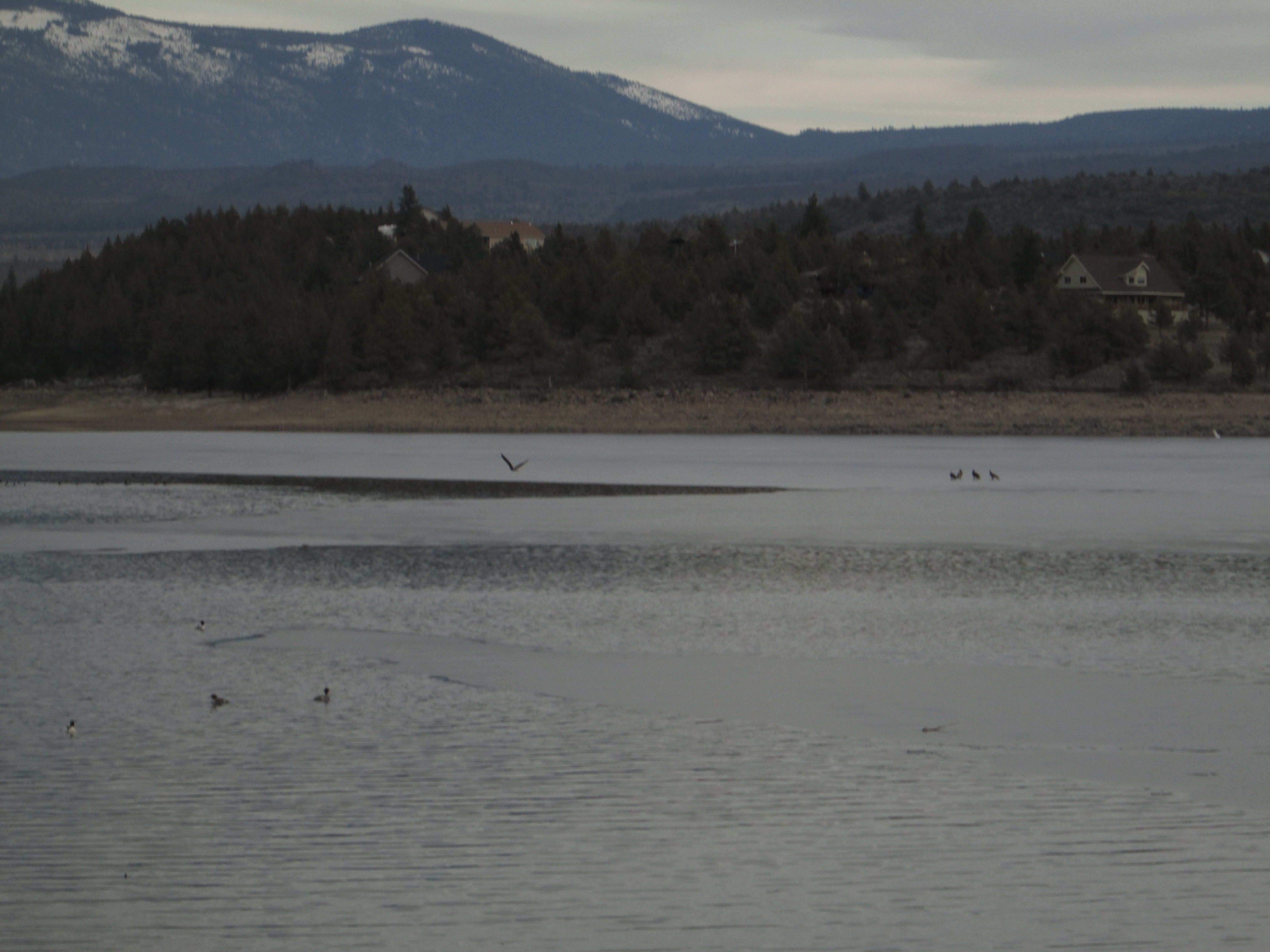
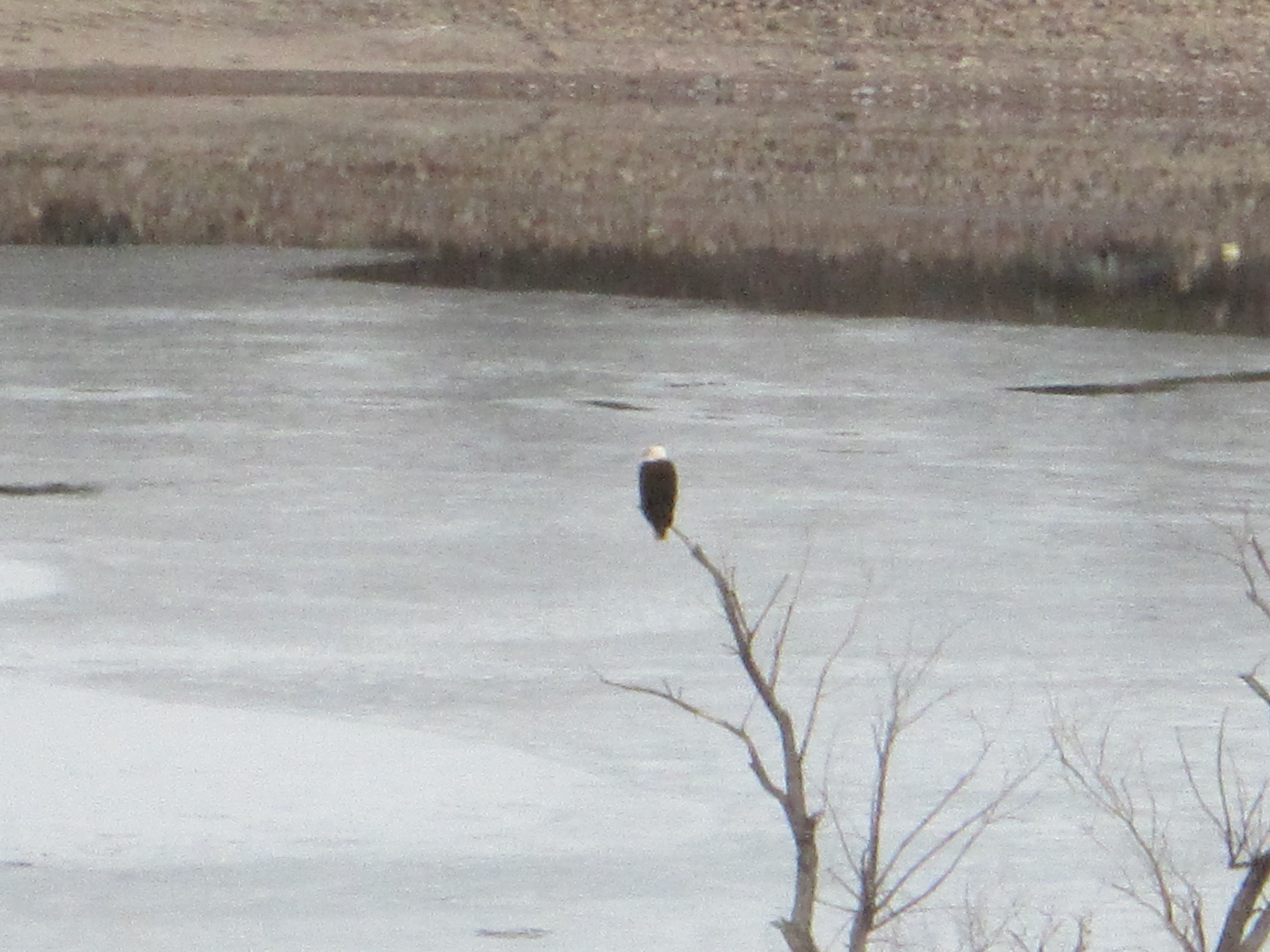
Nine Bald Eagles

Seven of them were spattered brown youths
hunched on a patch of lake ice
like old men bundled in rag-wool coats,
and two were perfect, gold-coin adults,
white helmets, bright yellow feet, floor to ceiling wings.
They glide, stall, swoop, pump,
beat the cold, still air-
kites without enough wind
wings flapping like sheets of newspaper
claws skittering across the ice.aIMG_0209

Canvasback ducks, thousands of them,
swim and chatter on the lake,
flashes of black and white as
they dip and flutter on the surface.
Their voices blending into uproar instead of birdsong,
a cloud of flickering emotions and games –
the chaos of a crowded school yard.
The eagles cruise the line of ducks
their down-beat ruffling the water.
The ducks keep feeding,
flicking water at each other, drifting out of the way,
nudging against the edges of the ice.
They spread away from the eagles
as if parted by a puff of wind.

Then, sudden screaming,
the ducks run across the water with a single mind
and collect at the edge of the ice,
climbing each other’s backs
flapping madly.
This is life or death, but why?

An otter materializes in the harsh black water
for just a moment
then submerges.